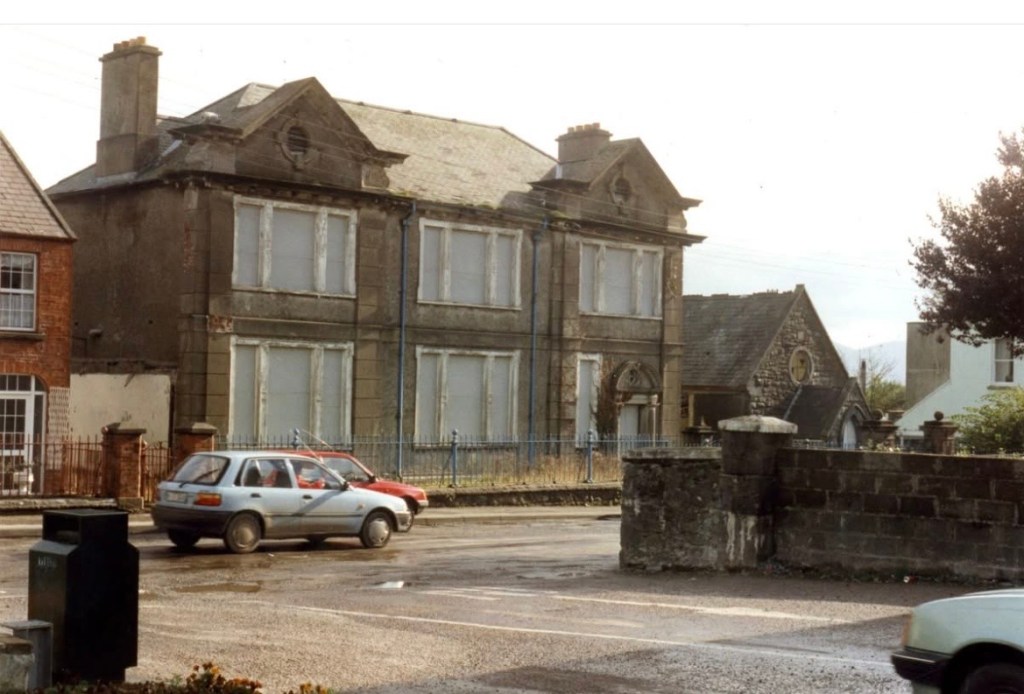
I attended secondary school at the Intermediate School in Killorglin, although to those of us who went there it was the Carnegie, the old library building in the centre of the town that had been divided, adapted and pressed into service over the years until there seemed scarcely a corner left from which another classroom might be fashioned.
By the time I arrived, the school had outgrown the building in every direction. Thirty or more of us sat in rooms conceived for far smaller numbers, desks pushed close together, bags under chairs and coats wherever they could be accommodated. Between classes, doors opened and the corridors filled within seconds, one class emptying as another tried to get through, while outside the prefabs absorbed the numbers the Carnegie could no longer hold.
On wet days we made the dash out to them and came back in carrying the Kerry weather with us. We knew no other version of secondary school and rarely questioned any of it. You learned the geography quickly: the stairs everyone seemed to reach at once, the places where the corridors narrowed, the routes that might save a few seconds between classes. The building had been stretched far beyond what had ever been intended for it, but it was our school and we knew how to inhabit it.
At the centre of its life was Joseph O’Dwyer.
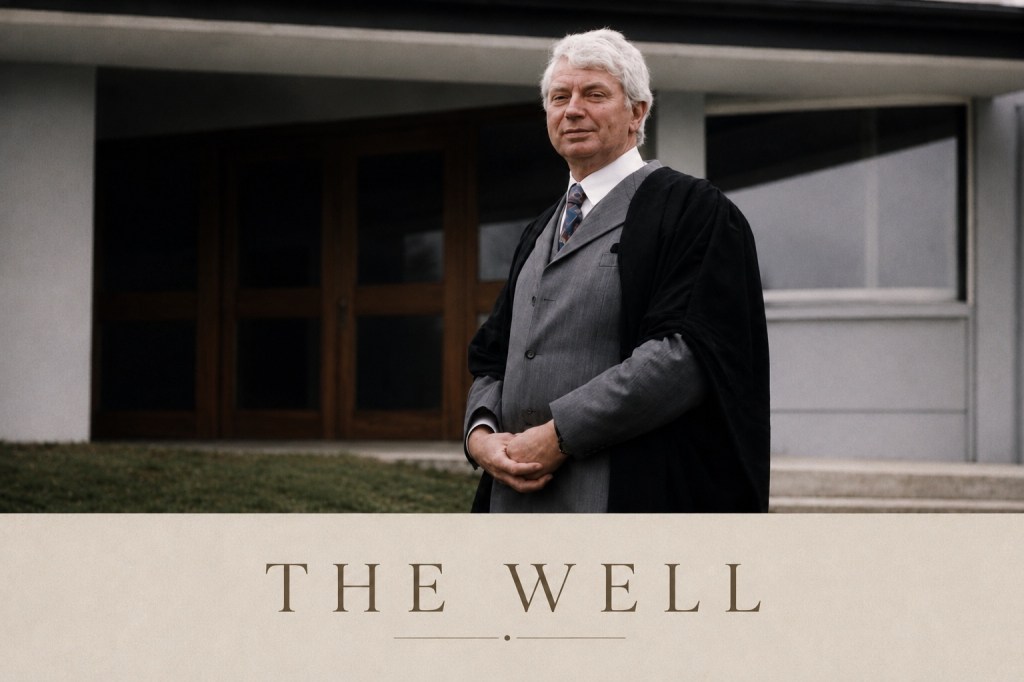
Joe was unlike anyone else I knew. He moved through the Carnegie in a black academic gown over a tweed three-piece suit, the gown following behind him through the press of students in the corridors.
Then there was the voice.
Rich, rounded and slightly muffled, as though the words had to negotiate their way around something before emerging, yet somehow carrying effortlessly. Joe didn’t really have a quiet voice. Whether addressing the entire school or two students he had encountered in a corridor, he spoke with the same magnificent projection, as though somewhere beyond us there was always a large hall that needed to hear him.
And then there was his “My gawd.”
Astonishment, exasperation and disbelief could all be contained in those two words, drawn out and rounded until they belonged entirely to him. You could hear them coming down a corridor before you saw the black gown.
In another man, the gown, the tweed suit and that extraordinary voice might have seemed theatrical. With Joe they were inseparable from the person.
He taught me Latin, which somehow seems entirely fitting now, but what he communicated most powerfully had little to do with any one subject.
Education was a serious business to him and his ambitions for the school reached far beyond examination results. Music mattered. Art, debating, public speaking and performance had their place alongside academic achievement. He expected young people to work hard, but he also expected them to discover things in themselves: the ability to sing, to act, to argue a case, to stand before other people and find a confidence or talent they might not yet know they possessed.
All of this was happening inside a building that had almost no room left to give.
For years Joe asked the Carnegie to become larger than its walls. It could determine how tightly desks were arranged, how crowded a corridor became or how many students had to make the journey outside to a prefab. What it could not do was persuade him to reduce his idea of education to fit the space available.
He never made the idea smaller to fit.
And within those restrictions a school flourished whose ambitions were far larger than the building containing it. Students performed, debated, made music and stood up to speak. Expectations were high, opportunities were created and the reputation of the school travelled far beyond the ageing walls of the Carnegie.
Then came the new school.
In the late 1980s, the Intermediate School moved to its new building on the Glenbeigh Road. I was fortunate enough to spend my final year there, moving directly from one building into the other.
What I remember first is the space.
After the compression of the Carnegie, there was room around us. Light travelled through the building, and you could look across it rather than only along a corridor. Several levels were connected by balconied walkways, opening the school vertically as well as horizontally.
After years in the Carnegie, the sensation was not merely of entering a newer building.
It felt as though the school itself had expanded around us.
At its centre was the Well.
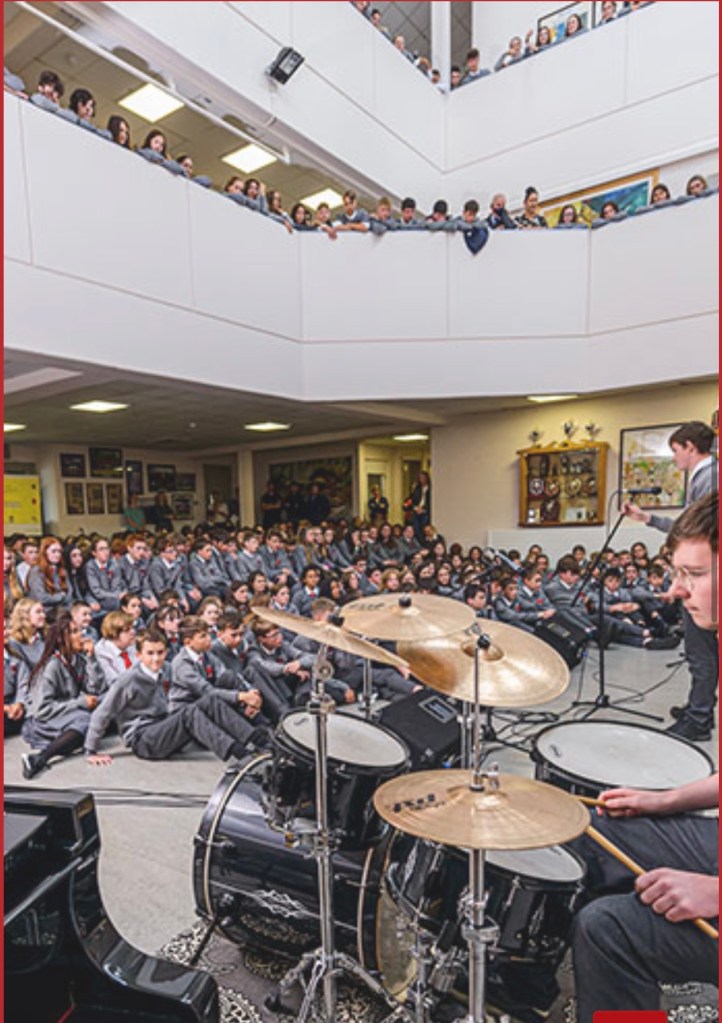
The floor dropped several steps below the surrounding corridors while the school rose around it through three levels, walkways and balconies overlooking the space from above. From the floor of the Well you were conscious of the building surrounding you; from the upper levels you could look directly into its heart.
We took possession of it quickly. Students crossed it, met there and lingered there. Announcements were made there, music was played and performances took place below while students gathered at the railings above. Someone walking to class might stop because something had begun in the Well and, without deciding to become part of an audience, find themselves watching.
What stays with me is how completely the Well understood the school that had arrived to occupy it.
It wasn’t an architectural attempt to create a culture of participation or community. That culture was already old by the time the building was new. It had been formed in the Carnegie, where space had always been scarce, but possibility had not.
Joe and the teachers around him had spent years creating an education whose ambitions repeatedly exceeded the rooms available to contain it. The new school gave that life a better home.
And the Well placed it at the centre.
We were teenagers and accepted the change with the speed young people do. Within weeks we knew where to meet, where to wait for friends and which balcony gave the best view of what was happening below.
A building that must have occupied Joe’s thoughts for years became ours almost overnight. For him, it could never have been quite so effortless. He knew what had crossed the town with us. The identity of the Intermediate School had not been left behind in the Carnegie. The expectations, confidence and breadth of education that had been formed there over decades came with us. The new building did not have to invent a future for the school. It had to be worthy of what was already there.
I couldn’t have understood that during my final year. It has taken the passing of time, a career spent in schools and my later fascination with buildings and interiors to recognise what I experienced in Killorglin. We often talk about the power of buildings to shape the people who inhabit them. The Intermediate School showed me the reverse: sometimes a culture is so firmly established that the architecture must find a way to give it form.
That was the Well.
I can still see it crowded with students, bodies leaning across the upper railings, others moving along the walkways and people gathering below. I can hear the mass of voices rising into the open centre of the building, then the change in that sound when something began and people stopped to listen.
And somewhere in that picture is Joe.
That is how I like to remember him. Standing at the edge of the Well, his black gown falling over the familiar tweed suit, the old Carnegie still somehow present in the man while around him rose a building made to accommodate the school he had already created. Students below him. Students above. Music rising through the space between them.
For years, Joe O’Dwyer’s vision had lived without the building it deserved. It had lived in teachers and students, in expectations, in performances, in voices finding the courage to be heard, and in an old Carnegie building stretched beyond anything its walls had been intended to contain.
The new school did not make that vision real.
Joe had already done that.
It gave it walls wide enough to hold it, light above it and, at its very heart, a Well around which the life of his school could finally gather.
Stay with Heron & Moss
New stories about people, places, home, memory and the ordinary things worth noticing. A new story, occasionally.


Leave a comment