The Same Words, Differently
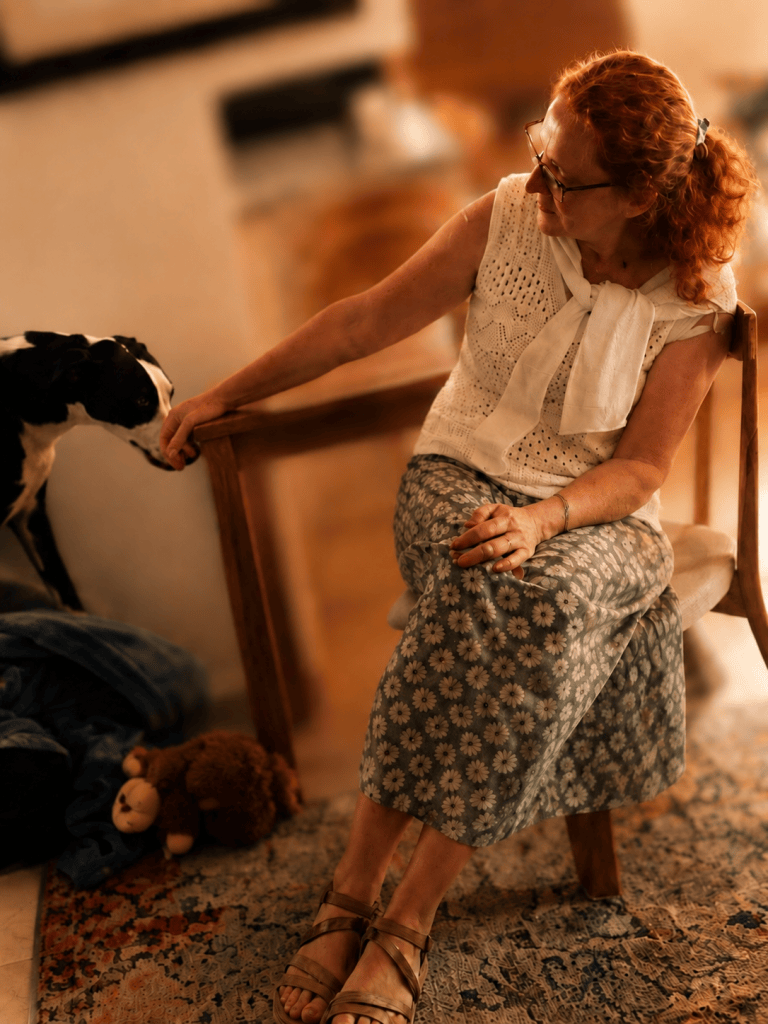
Claire Baley with Jillian and Sophie’s whippet Bea
We are sitting in a booth facing the piano at Jack’s in Cromane when an eighty-two-year-old man none of us knows decides that everyone in the restaurant should stand up and hold hands.
There are six of us at the table — Claire and Jonathan, Sophie and Jillian, my wife Claire and me — and from where we are sitting we can see the whole thing unfold. Chairs move, people turn towards neighbouring tables, hands are offered to strangers and, without any of us being quite sure what we have signed up for, we join in.
The man responsible is the driver for a group of Americans from New Jersey sitting nearby. They have been coming to Ireland for forty years, their parents travelling with them when they were alive, and the same driver has looked after them year after year. He is eighty-two now, still driving them and, as we are quickly discovering, more than capable of taking charge of a room.
He has already entertained us with a few Irish ballads, JP picking them up at the piano and doing what he does so well, following the singer, judging the room, holding the whole thing together. Then comes the instruction to stand.
So there we are, an entire restaurant linked by the hands, exchanging slightly sheepish smiles and waiting to discover what exactly is expected of us.
JP begins to play.
The Banks of My Own Lovely Lee.
We have been manoeuvred onto our feet for the Cork anthem.
The room erupts in laughter, and once our eighty-two-year-old master of ceremonies has achieved the considerable feat of getting everyone standing, he has no intention of letting us sit down again. Sweet Caroline follows, then New York, New York, and somewhere along the way dinner gives itself over completely to the evening. People leave their tables, voices join in, strangers begin talking, somebody is dancing, then everybody seems to be dancing, and JP keeps it moving from the piano as though this was where he knew the night was heading.
I find myself watching Claire and Jonathan in the middle of it. There is no hanging back, no polite amusement from the safety of the table. They are up with everyone else, singing, laughing, holding hands with people they have never met, taking the whole slightly mad turn of events in their stride.
The Americans are having a ball. There is something rather lovely about watching them too, knowing they have been making this journey for forty years, once with parents who were part of these holidays and are no longer here, and with the same man still driving them around Ireland, now eighty-two and singing Irish ballads in Cromane.
The Ireland they first came to must have looked very different. They certainly were. Yet here they are again.
None of us dwells on it for long. New York, New York is playing and we are too busy dancing.
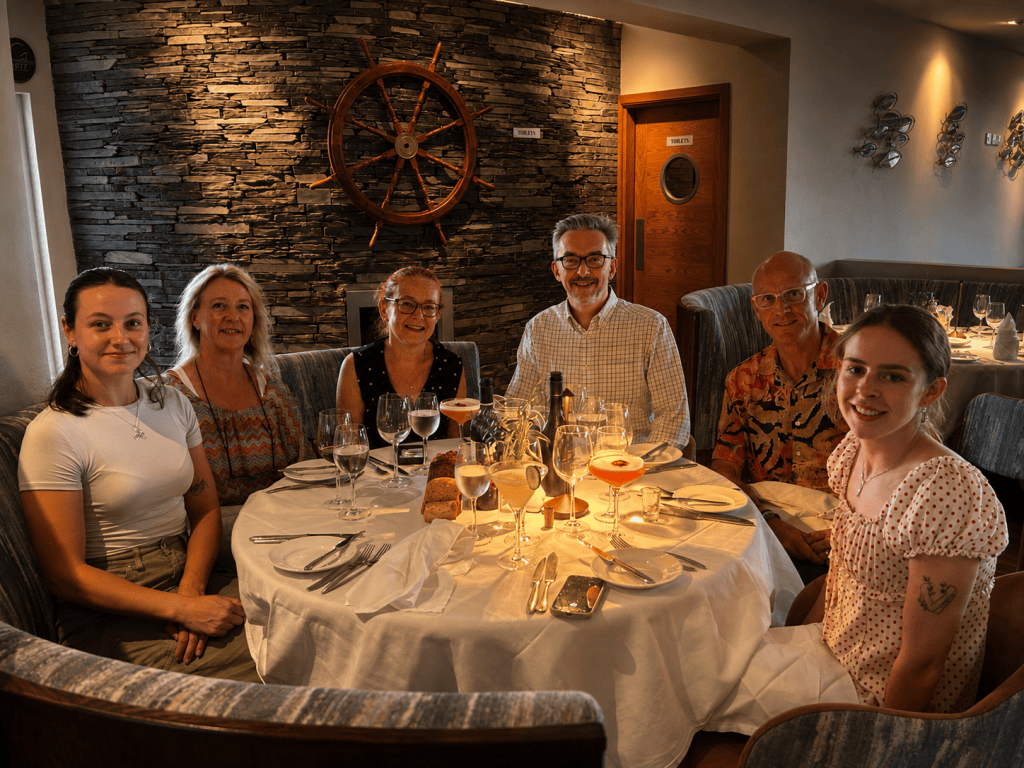
An evening at Jack’s Restaurant, Cromane
Later, back at our house in Glenbeigh, we settle in for a nightcap. The pace has quietened but the conversation hasn’t, and with Claire and Jonathan it can wander a fair distance. Both are exceptionally well informed, particularly on history, geography, politics and the world around them, but there is nothing heavy about it. One thing leads quite naturally to another.
Somehow we get to de Gaulle and Pétain.
My Claire is immediately engaged. So are Jonathan and Claire Baley. I listen intently and contribute considerably less, partly because history and politics are not areas in which I can claim any great authority, but mostly because I enjoy listening to the three of them.
They are talking about Pétain, once celebrated in France as the hero of Verdun, and the man he would later become as leader of Vichy France. How do you reconcile one with the other? Someone remembers a detail, someone else adds to it, my Claire questions something and the conversation turns again. At times I am still getting one part straight in my head while they have already moved comfortably on.
Jonathan is unlikely to let anything remain solemn for long. He has a dependable supply of dad jokes and no embarrassment about using them, and there is something very easy about a man who can spend part of an evening discussing French history and another singing Sweet Caroline with a restaurant full of strangers. He plays piano and ukulele too and seems entirely comfortable wherever the evening takes him.
Claire has that ease about her as well, though in a quieter way. Sitting there listening to her talk about France, I realise how naturally she has fitted into the weekend — Bea beside her at home, laughing with strangers in Jack’s, now deep in a conversation that has travelled from Cromane to twentieth-century France.
At some point I ask where in France she grew up.
Bégard, in Brittany.
And what was it like?
Boring, she tells me.
There is something wonderfully unromantic about the answer. No qualification follows, no attempt to improve her younger self with hindsight. She was a young woman in a small Breton town, surrounded by countryside she had known all her life, and she wanted to see what else there was.
So she did.
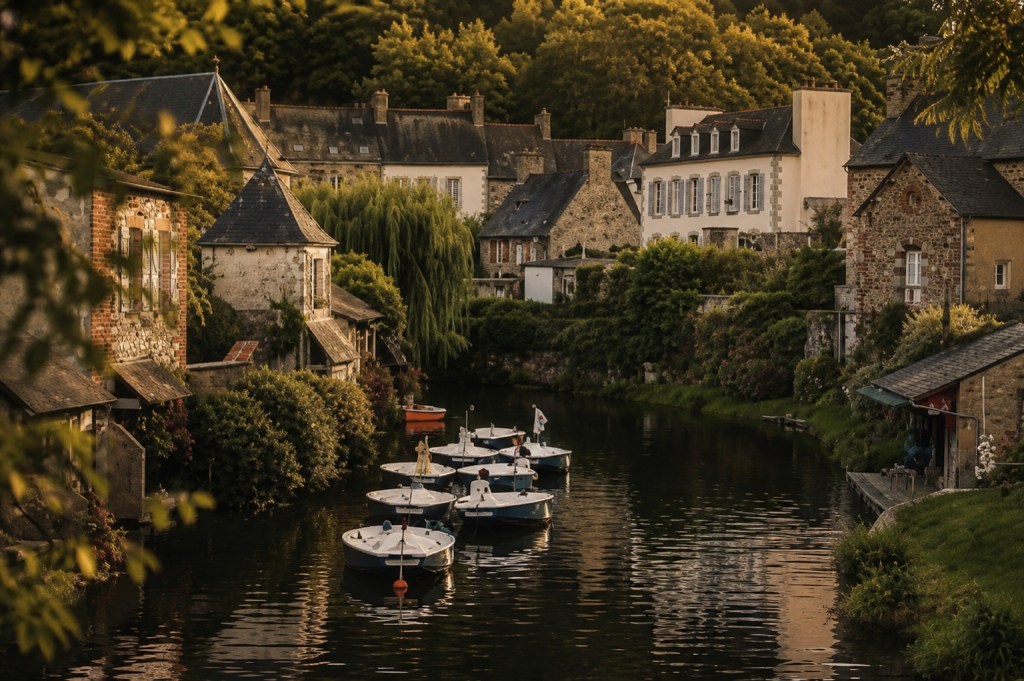
Bégard, Brittany — the place Claire still calls home.
Her parents were both teachers, her father at secondary school and her mother at primary, but they had little interest in producing another teacher simply because that was the life they had chosen. They encouraged Claire to do what felt right for her, even when it began to carry her further from Bégard.
She studied English and Spanish at university, specialising in translation, spent some time afterwards in England working as an au pair and came to Ireland in 1989. Looking at her now, with her red hair and fair skin, there is something distinctly Celtic about her; without hearing her speak, I doubt many people would immediately place her as French.
For a while she did follow her parents into teaching. She worked in Dublin, including Dalkey and Kilbarrack, and in Kilbarrack found herself in the same school as Roddy Doyle. She remembers the authority he had with the students, how a word from him could bring them quickly to attention while she had to work considerably harder for the same result.
She could teach. She simply didn’t feel the vocation her parents had.
Translation had held her differently from the beginning, and she eventually moved into company life, working for a time with Microsoft and later with other companies and vendors. What she had studied at university became her career.
When Claire talks about translation, I realise my own understanding of it has always been rather literal. Know two languages well enough, find the right words in one for the words written in the other, and surely the job is more or less done.
Not at all.
You can translate a sentence perfectly and still get it wrong. Humour can disappear on the journey. Warmth can harden into formality. Something light and playful in French can sound faintly ridiculous in English, while a phrase meant to persuade can suddenly feel pushy or insincere. Every word can be accounted for and yet the sentence somehow arrives without the thing that made it work in the first place.
Much of Claire’s translation now is in marketing, where that distinction matters enormously. The words are being asked to do something — persuade, reassure, amuse, attract attention — and their exact equivalent in another language may simply fail to do it.
There is judgement in that which I had never considered. Claire isn’t only translating what somebody has written; she has to understand what they hoped the words would achieve. It is also, perhaps, where the limits of artificial intelligence become apparent. A machine can offer the equivalent word, construct the sentence, even imitate the tone. But knowing when something sounds just slightly wrong — when the humour has gone missing, or the warmth has cooled somewhere between one language and another — requires something harder to programme. It requires an ear for people.
At around forty-six she left company life and began working freelance from home, which suits her very well. Claire describes herself quite happily as an introvert. She likes the independence, the concentration and the quiet, and doesn’t miss having an office around her.
What I like is that she doesn’t assume because this life suits her now it must suit her two daughters, Sophie and Lucie. At their stage, she thinks, they need people around them — friends, colleagues, connections, the person at the next desk, conversations over coffee, invitations after work, all those accidental encounters that have little to do with the job itself and can become an important part of a life.
Her parents still live in Bégard and Claire goes back regularly. Somewhere over the years she also began to see the place differently, particularly the countryside she barely noticed when it was simply the backdrop to growing up.
Claire and Jonathan made their life together in Bray, where they raised Sophie and Lucie. Their visits to Glenbeigh have become something my Claire and I look forward to, and usually in the autumn we make the journey in the other direction. We enjoy our visits to Bray too.
Sophie is Jillian’s partner, which is how our families came together. She works with sign language, while Lucie studied performance arts in London, with dance an important part of her world. Jonathan has his music, Claire her languages, and it would be easy to make something rather neat out of all those different forms of communication. Families rarely arrange themselves so obligingly.
What stays with me instead is Sophie sitting beside Jillian at dinner in Cromane. When Claire left home as a young woman, there was no way of knowing that one of the countless consequences of that decision would eventually be sitting across the table from us.
At some point in Jack’s, before the singing and dancing took over, someone took a photograph of the six of us around the table. Looking at it afterwards, there is nothing particularly remarkable in what the camera has caught: six people having dinner, glasses on the table, a night out in Kerry.
It cannot tell you very much about any of us. The camera has no knowledge of the decisions, accidents, departures and arrivals that brought these particular six people to the same table. It cannot explain Sophie and Jillian, or why Claire and Jonathan are now people whose visits we look forward to, or why an ordinary dinner in Cromane has become part of a longer story.
The Americans at the next table have their own history beyond the frame: forty years of returning, parents who once travelled with them and are gone now, the same eighty-two-year-old driver still turning up, still singing, still adding himself to their memories.
A photograph gets the faces. The years that brought them together are harder to see.
And perhaps that is why, after everyone has gone to bed and the conversations of the evening have settled, I find myself thinking again about Claire and translation.
A successful translation cannot be slavishly faithful to the original words. Claire knows that better than I do. You can preserve every word and lose the humour, the warmth, the intention — the very thing that made the words worth translating in the first place. The real skill lies in knowing what can change while still carrying what matters.
Claire’s life has travelled a fair distance from where it began, although listening to her now, very little of it feels like a departure from the person who first wanted to go.
Yet Bégard has not been lost in the translation.
Her parents are still there. Claire still goes back. And the countryside she once barely noticed has become part of what she returns for.
Perhaps that is the thing I understand better after listening to her.
Sometimes moving away from the original is the only way to carry its meaning with you.
Claire did.
And she still knows her way home.
Stay with Heron & Moss
New stories about people, places, home, memory and the ordinary things worth noticing. A new story, occasionally.


Leave a comment