Provenance
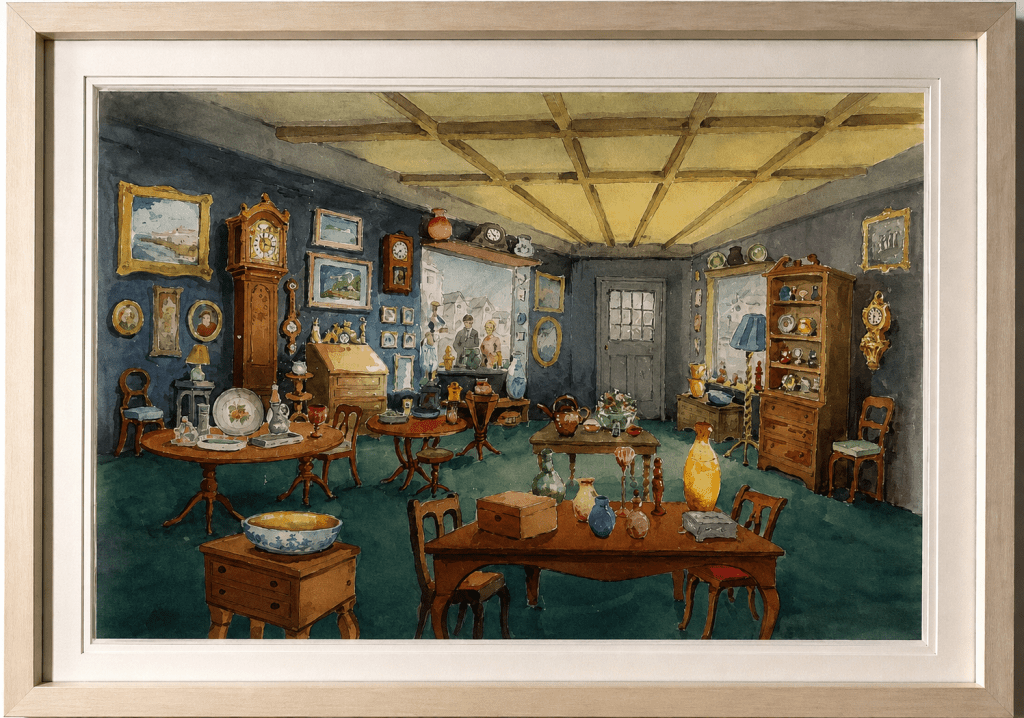
The watercolour I chose from my father’s antique shop after he died.
There is a watercolour hanging in our house of an antique shop I have never known. It is a long, crowded room with a blue-green floor, clocks high on the walls and pictures fitted into the spaces between them. Tables carry bowls and jugs, cabinets hold smaller things behind glass, chairs occupy whatever room has been left for them. Light enters towards the back and catches on a clock face, the edge of a picture frame, a piece of polished timber. It is a painting that rewards looking; stay with it for a while and something else emerges from the clutter.
I don’t know where the shop was, or whether it ever existed quite as the artist painted it. I don’t know who owned it or what became of it, and I have never made any serious attempt to find out.
The painting came from my father’s antique shop.
His looked nothing like it.
My father had been collecting old things for most of his life. Long before there was a shop, watches and books, pieces of furniture, old cutlery and pottery, lamps, enamel signs and all manner of things had begun to gather around him. He had an instinct for looking twice at something another person had finished with, for turning it over in his hands, finding a mark, wondering where it had come from. By the time he retired from An Garda Síochána at fifty-six, collecting was already part of his busy life. Retirement simply gave it more room.
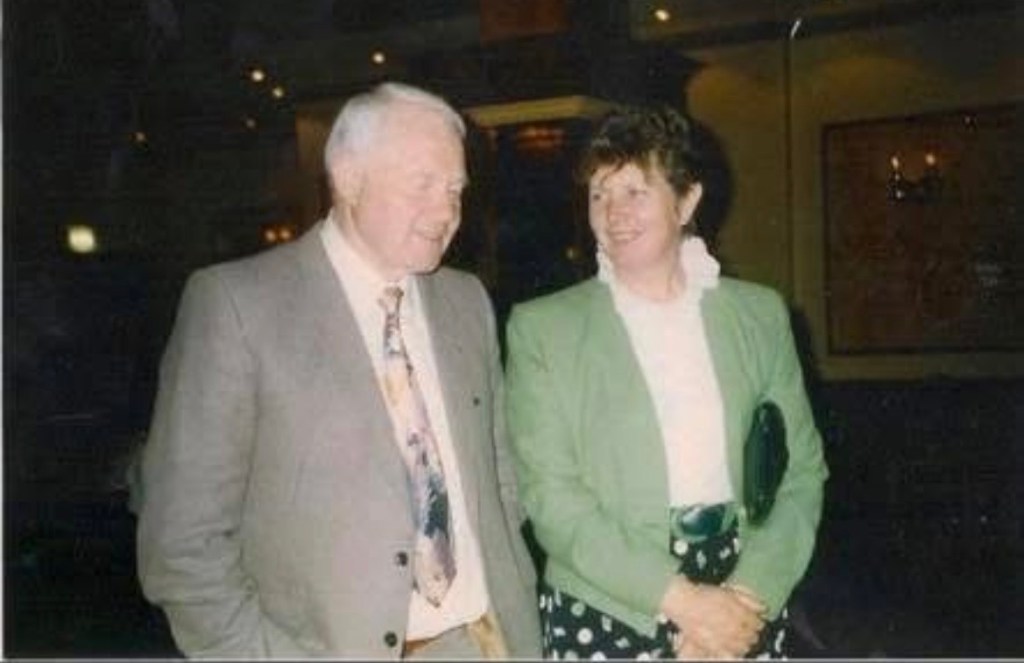
My father and mother on the night of his retirement from An Garda Síochána.
He bought Harris Cottage, a small cottage just outside Glenbeigh, opposite the entrance to the Glenbeigh-Glencar football field and immediately beside a piece of land known locally as the Fair Green which, as far as I remember, he had bought some years earlier.
Harris Cottage suited him.
The corrugated roof needed repairing, so he repaired it. The interior was limewashed. Very little else was done. The great open fireplace remained, broad and dark against the white walls, with the old iron arms still reaching out across the hearth. From them my father hung black kettles and pots, no longer needed for what they had been made to do but looking as though they had never really left.
Then he filled the cottage.
Enamel advertising signs went onto the walls. Cream and brown stoneware pub jugs gathered on shelves and tables. There were Tilley lamps with their glass globes, plates and watches, old knives and forks, books with softened spines, chairs, tables and cabinets, and smaller things occupying whatever spaces remained. Timber had darkened with age, brass had dulled, paper had yellowed. There was the smell of old wood and books, metal and dust, with perhaps a little damp belonging to the cottage itself, and the occasional flash of light caught in glass.
Nothing matched. Nothing needed to.
To us it was simply Dad’s shop. Familiarity had made us poor observers of a place that fascinated strangers.
My father missed very little.
Lift something from a shelf and he knew where he had bought or found it, often who had owned it, what he had paid and what he believed it was worth. If you wanted to buy it, he knew what he would take for it too, which was not necessarily the same figure. There was usually something behind the object itself — a house, a person, a sale, a chance discovery — and he seemed to carry all of it without effort.
If we wanted to know, we asked him.
Publicans were particularly fond of Harris Cottage. There was an appetite by then for the remains of an older Ireland: enamel advertising signs, stoneware jugs, Tilley lamps and the ordinary domestic things that had been cast aside as houses modernised and ways of living changed. Things one generation had been glad to replace were sought out by the next because the world in which they had been ordinary was disappearing.
Tourists came too, wandering into that little cottage outside Glenbeigh and leaving with a jug or a plate, a lamp or an old sign wrapped for the journey home. I sometimes wonder where those things are now. A pub jug that once sat on one of my father’s shelves may be on a dresser somewhere in America; an enamel sign may hang above a bar in England; a plate bought during a holiday in Kerry may have passed to somebody who has never been here and knows nothing of the cottage where it was found.
Almost everything in Harris Cottage had arrived from somewhere else in the first place. A lamp might have lit a kitchen until electricity made it redundant, spent years unwanted in a shed and eventually appeared on one of my father’s tables. From there it could leave in the boot of a car because somebody saw in it something worth keeping.
The light it had once been needed to provide was gone. The lamp remained.
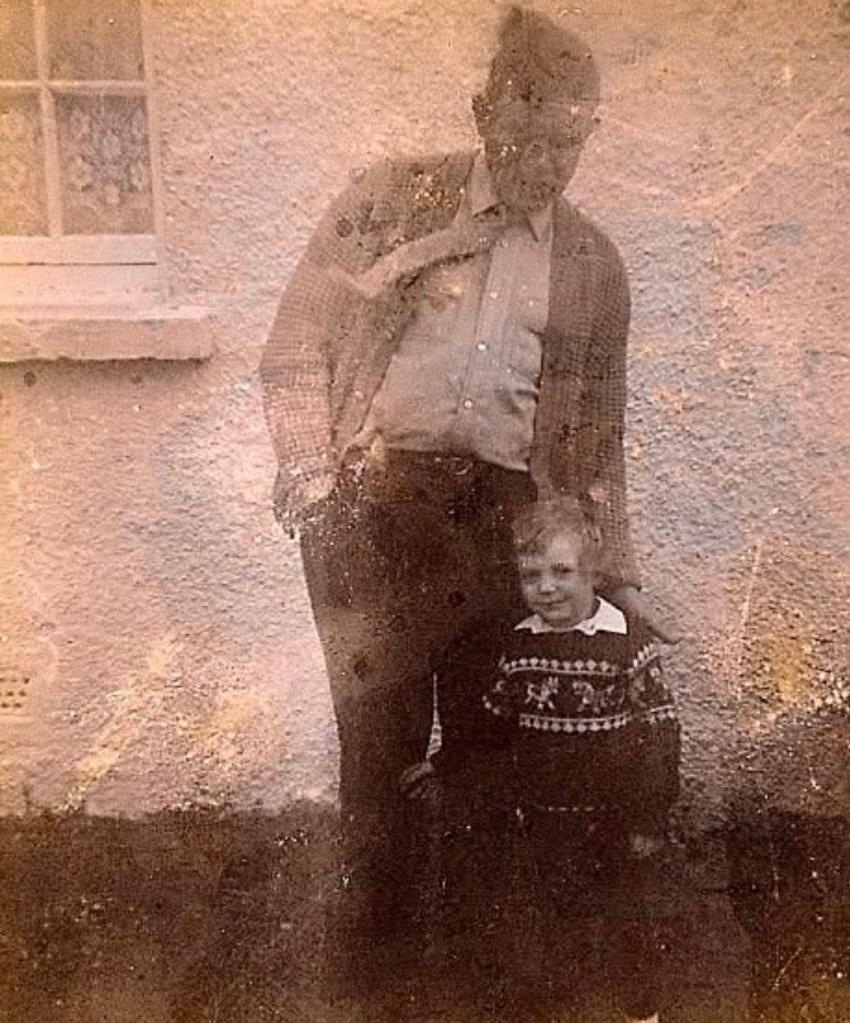
My father, in an earlier photograph.
Some years later Harris Cottage itself was demolished and a new building, divided into three apartments, took its place. The centre apartment became the new antique shop. The corrugated roof, limewashed walls and old open hearth disappeared, but the contents made the short journey.
The old cottage was gone, but Dad was still there.
For us, that was continuity enough.
In 2005, Claire and I began building our house on the Fair Green, the land my father had bought beside Harris Cottage. My parents began theirs next door the following year. For a while there were two houses rising side by side, blockwork and scaffolding, stacks of timber and piles of sand gradually giving shape to rooms that existed first only on drawings.
We moved into ours in September 2007.
By then the ground my father had bought years earlier had become somewhere very different. Claire and I were making a home there, and next door my parents’ house continued to rise.
My father died in October 2008, when their house was nearly finished. He never got to live in it. My mother completed what they had begun and made her home there, and she lives there still. We recognised the objects, could pick them up and remember where they had stood, but the histories that had once seemed to belong to them had belonged, in truth, to him. Suddenly there was no longer anyone to ask.
Where exactly had that come from? Who had owned it? Why had he bought it? Was it valuable, or had he simply liked it? Questions that would once have taken seconds to answer had nowhere to go.
Families carry an extraordinary amount of knowledge this way, without ever deciding to. It resides in people rather than documents: who lived in a particular house, why a field has its name, where a table came from, who gave somebody a bowl, why one thing was kept when another was thrown away.
Nobody thinks to record it because somebody knows.There will be time to ask.Until there isn’t.
We weren’t equipped to carry on the business and eventually my mother sold the contents of the shop to an antique dealer in Tralee. I wasn’t there for the removal, for which I’m very glad. I never saw the shelves empty or the pictures come down. I don’t know what left first or what was carried through the door last.
There are some scenes I am content not to possess.
The shop I remember is full.
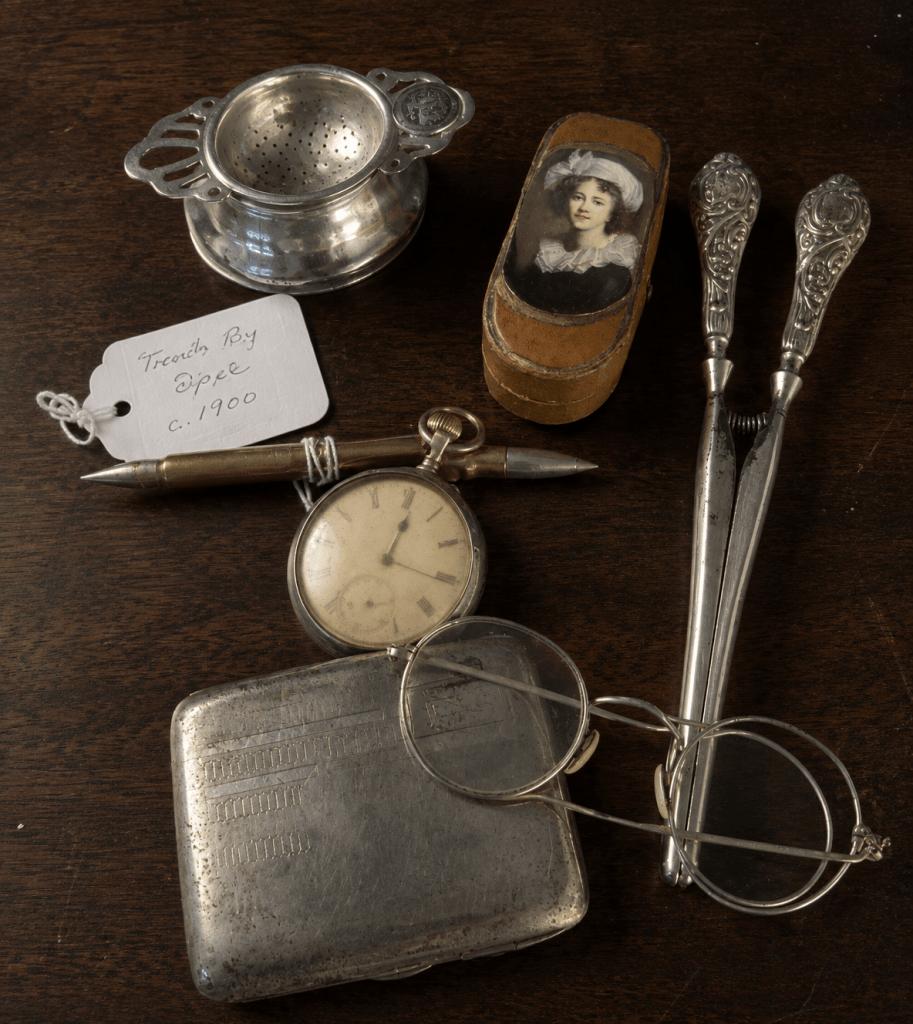
Some of the smaller pieces I chose from my father’s antique shop after he died.
Before everything went, we were allowed to choose a few pieces for ourselves. I kept several, and among them was the watercolour.
There were more obvious things I might have chosen. Older things, more valuable things, objects my father had owned for years and pieces with a clearer connection to him. Yet I wanted this picture of an antique shop that bore almost no resemblance to his.
I couldn’t have explained why then, and I don’t want to pretend that I can entirely explain it now. Memory has a tendency to make our earlier choices look wiser than they were. I liked the painting. Something in it connected with me, so I brought it home.
It has hung here ever since.
Most days I barely notice it. It has been on the wall long enough to become part of the room, present through breakfasts and dinners, Christmases, conversations, visitors, doors opening and closing, the countless repetitions through which a house becomes inseparable from the life lived inside it.
But every so often I stop.
The room in the painting hasn’t changed. The blue-green floor is still there, the clocks remain on the walls, the jugs on the tables.
Yet somewhere over the years another room has found its way into it.
There is nothing accurate about this. Harris Cottage had no blue-green floor, no broad dark fireplace in the painting, no black kettles hanging from iron arms. The furniture is wrong. The light is wrong.
Memory doesn’t seem to mind.
Sometimes all it needs is a jug on a table, the glass of a lamp, a clock high on a wall, something partly hidden behind something else, and Harris Cottage returns.
Not as an inventory. What comes back is less orderly than that: the darkness of the hearth against the white walls, the brown and cream of the pub jugs, the glass globes of the Tilley lamps, old books, timber and brass, one thing leading the eye towards another.
And my father among them.
He would have been ninety today, August 18th, 2026.
There is something strange about assigning an age to somebody who has been gone for so long. I cannot really picture my father at ninety. The man who comes to me is younger and moving, still connected to the places in which I knew him. I can see him far more readily in Harris Cottage, surrounded by all those things whose histories he carried so effortlessly, than I can imagine the old man he might have become.
Perhaps that is why the painting matters more to me now than it did when I chose it.
Whatever its story was before my father acquired it, I don’t know. It spent some time among the things in his shop. After he died, while almost everything around it was preparing to move elsewhere, I chose it and brought it the short distance home.
It hangs now on a wall on the Fair Green, the ground my father bought years ago. My mother is next door in the house she and he began. Harris Cottage is gone, and most of the things it once held have travelled on.
I have never discovered where the antique shop in the painting really was.
I think now I would rather not.
My father knew what came before. I know what came after. And every so often, when I stop in front of it, the distinction between the two shops disappears altogether.
The painted room remains exactly as it was.
But the shop I see is full of my father’s things.
And he is still there.
 Heron & Moss
Leave a comment