The Island I Thought I Knew
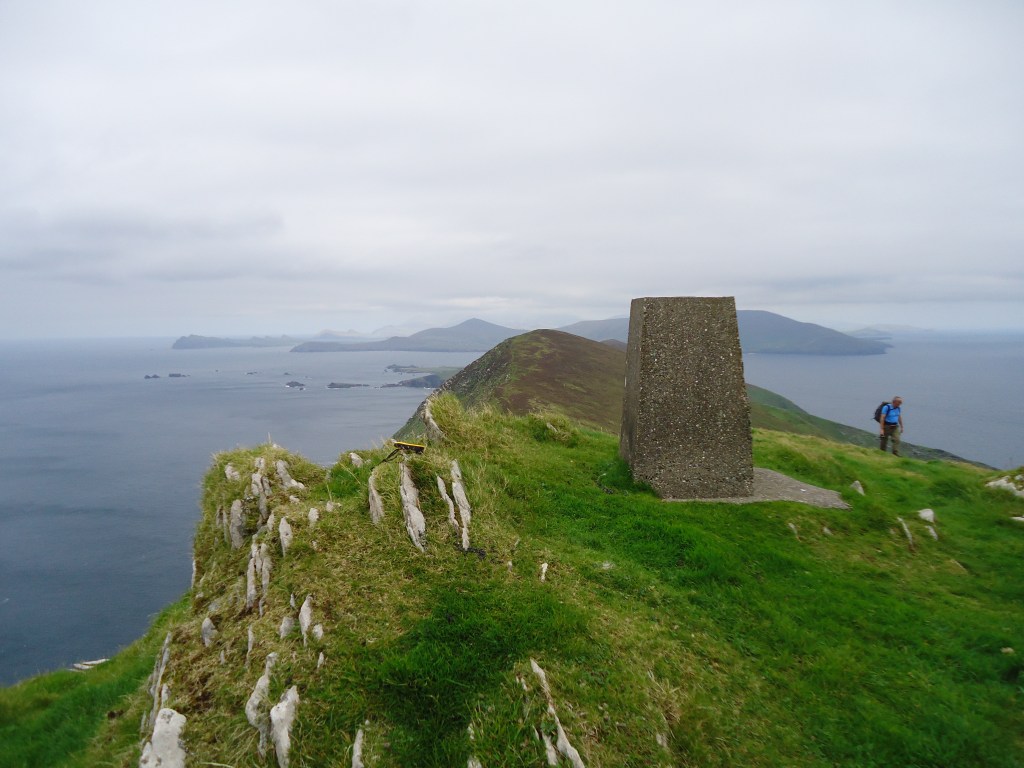
The summit of the Great Blasket, where, for a few strange minutes, everything around me seemed to fall away. Photograph: Michael Earnshaw / Wikimedia Commons. CC BY-SA 2.0.
During my years as principal of Kiltallagh National School, from 2003 to 2007, we brought the children to the Gaeltacht for a few days. We stayed in a hostel and spent some time in Scoil Naomh Gobnait in Dún Chaoin, where Máirín, the príomhoide, and another teacher whose name I can no longer recall made us very welcome. I knew this part of Kerry reasonably well by then. I had spent several summers in the Gaeltacht as a young teenager and returned as a college student, staying in Feothanach and Muiríoch. We had even visited Peig Sayers’ old home on the mainland at one stage. I knew the landscape and how beautiful it could be, and I was used to hearing Irish spoken around me. The Great Blasket, however, was somewhere I had never been.
I had known about the island since I was a boy, mainly through Peig, a book that many people of my generation remember with something approaching dread. I seem to have been unusual because I loved it. I loved the language, particularly the turns of phrase, the discovery that something I understood perfectly well could be expressed in a way that would never have occurred to me. There was a musicality to it that I enjoyed even then, and which, strangely, seemed to survive translation into English. Perhaps some of that came from words that had first been spoken, from a culture where stories were told and listened to before somebody thought of putting them on a page. Whatever the reason, the language stayed with me, and so did the island I had constructed from it.
One afternoon we made our way down to Dún Chaoin to take the boat across. By then Peig was the last thing on my mind. I was a young principal bringing a group of children out onto the Atlantic, some of whom were nervous about getting on the boat in the first place. There was plenty of reassurance from the adults, myself included, as we got everyone safely aboard and settled before heading out. It wasn’t a long crossing, and as the Great Blasket came closer we discovered something nobody had thought to mention. The boat wasn’t going to bring us all the way in.
For the last part of the journey we had to transfer into much smaller dinghies. We divided the children into groups so that an adult travelled in each one and began getting everybody down into them, a few at a time. Looking at those little boats moving beneath us, I felt considerably less confident than I had sounded when reassuring the children earlier. One group went and then another, children being helped down and an adult going with each group, until everyone was safely ashore.
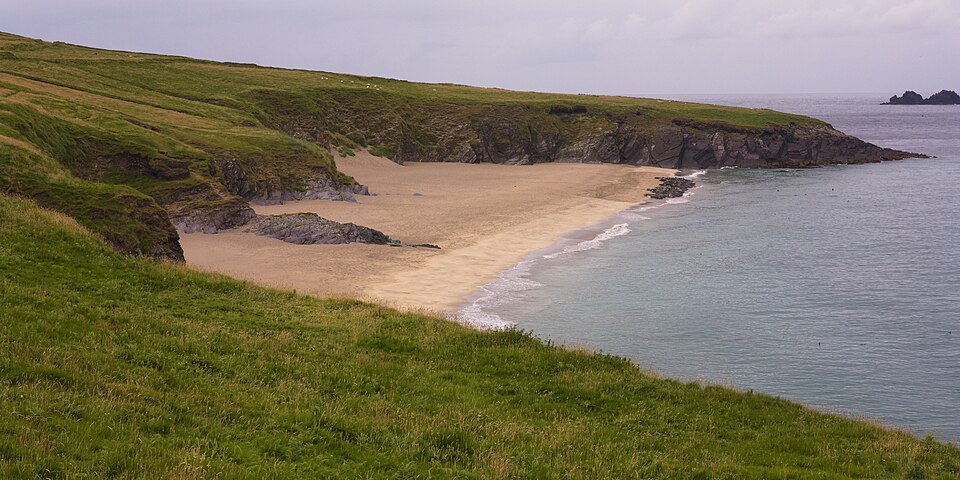
The beach where we first came ashore on the Great Blasket, the seals gathered along the water’s edge.
Photograph: Maciej Brencz / Wikimedia Commons. CC BY 2.0. Cropped from original.
The smell from the seals was overpowering. There were great numbers of them stretched out along the beach and I had never seen so many together. It was probably not the first impression of the Great Blasket that Peig had prepared me for, but it was the one I got. The seals seemed entirely unconcerned by us, lying there while a group of children and teachers from Kiltallagh arrived among them, and after the uncertainty of the dinghies and the concentration involved in getting everyone safely onto the beach, we were glad to be standing on solid ground.
The seals along the shore were impossible to miss. The smell was even harder to ignore.
We began climbing from the beach and spread out a little as we went. We had been spoilt with the weather, a beautiful day with blue skies and sunshine, and the higher we climbed the more we could see. None of that was new to me. I had spent enough time in West Kerry to know what it could look like on a day like this and had seen this coastline in all sorts of weather over the years. I was enjoying the climb and enjoying being there, but nothing up to then felt very different from other beautiful places I had known.
Then we reached the top.
For some reason I stopped, and what happened next is still difficult for me to put into words. I felt completely alone. I don’t mean lonely, because there was nothing sad or frightening about it. The children were there and the other adults were there, but for a short time I had no awareness of them. There must have been wind at the top and the sound of the sea, children talking, people moving around me, yet I wasn’t conscious of any of it. I couldn’t hear anything. I wasn’t looking for anybody or wondering what we were doing next. For those few moments all of that seemed to have gone.
What I felt instead was an extraordinary peace, something I had never experienced in quite that way before. The nearest comparison I can make is with accounts I have read of people who came close to death and afterwards described feeling that they had somehow left their bodies for a short time before returning. I have no idea what that feels like, of course, and I am not suggesting that what happened to me was anything of the sort. It is only the nearest comparison I have for the peculiar sensation of being there and yet somehow apart from myself. There was no fear in it and no attempt on my part to work out what was happening. I felt completely alone and completely at peace, and for however long it lasted, that was enough.
As the feeling passed, I became intensely aware of everything around me. It was the same island and the same beautiful day I had been looking at on the way up, but I was looking at it differently now. My attention seemed to move very slowly from one thing to another and, wherever it settled, I became absorbed in what I was seeing. I looked across the island, towards the mainland, down at the water, back towards the old houses and the children moving around, and each time my eyes settled somewhere I wanted to stay with it before looking elsewhere. Nothing had changed, yet everything seemed to require more time.
The closest I can come to describing it is that things appeared to be happening in slow motion. The children hadn’t slowed down and neither had the sea; it was my own looking that had changed. I was taking things in one at a time, becoming captivated by them, and the more I looked the more I wanted to continue looking. It felt almost cinematic, except I wasn’t watching the island from outside. I was standing in the middle of it, on a day of blue skies and sunshine, seeing a place I had known about for years with a concentration I had never brought to it before.
When somebody eventually said we’d better start heading back, I wasn’t ready to leave. I would happily have stayed at the top much longer, but we had children to bring home, so we gathered everyone and made our way back down towards the beach. The seals were still there and so were the dinghies, and we divided ourselves into groups again, an adult with each, before transferring to the larger boat and crossing back to Dún Chaoin.
We brought the children safely home to Castlemaine and then turned around and drove west again. Caroline, Deirdre and Clodagh came back with me to Dingle, where we joined Máirín and her colleague for dinner in Fenton’s before spending the night in Benners Hotel. With the children safely returned to their parents and the responsibility of the previous few days lifted, we could sit around a table with the two women who had welcomed us into their school.
Only with the passing of time did I begin to think differently about Peig and the water we had crossed that afternoon. She too had begun on the Dún Chaoin side, born there before coming to the Great Blasket as a young woman when she married Pádraig Ó Gaoithín. I had known the outline of her story since school and had even visited her old home, yet the significance of that short crossing had largely escaped me. We went over in sunshine knowing we would be collected again. Peig crossed to make her life there. What gave me such freedom for an afternoon was part of the geography that governed hers.
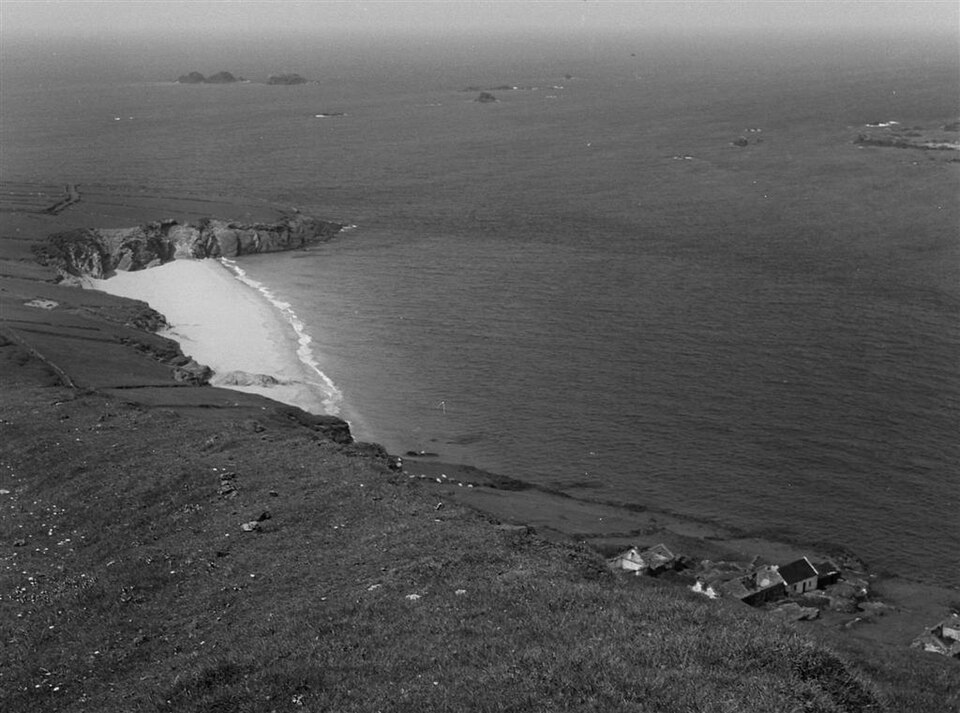
The old village on the Great Blasket, photographed in 1960, seven years after the island was evacuated.
Photograph: M. J. Richardson / Wikimedia Commons. CC BY-SA 2.0.
That has made the Peig I loved at school more interesting to me rather than less. The book is often remembered as an accumulation of hardship, bad weather and death, but what held me was always the language and its closeness to the things people depended upon: land, animals, food, neighbours, weather, the sea. One phrase in particular has remained with me: féar dhá bhó — the grass of two cows. I loved it then and I love it now. Why tell me the acreage when you could tell me how many cows the ground would feed? An acre and a half gives me a measurement; féar dhá bhó gives me the cows standing there and some sense of what that piece of ground could provide. Even as a boy, I think I understood that there was more life in one way of saying it than the other.
Years later I came across liú na róinte, the cries of the seals, and fuaim na dtonn, the sound of the waves, in the writing of Muiris Ó Súilleabháin. I like those phrases before I even translate them. The seals and waves aren’t there to decorate the writing; they were part of what he heard because this was where he lived. My own encounter with na róinte was considerably more concerned with their smell, but I like that too. I had arrived carrying an island made partly from words and was met first by something no book could have prepared me for.
I don’t want to explain what happened at the top any further than I can. I wasn’t thinking about Peig or Muiris when it happened, or about language, history or island life. For those few moments I wasn’t even conscious of the sea.
Féar dhá bhó. Liú na róinte. Fuaim na dtonn. The grass of two cows, the cries of the seals, the sound of the waves.
Peig had looked out at an fharraige sin amuigh — that sea out there.
Muiris had listened to fuaim na dtonn.
I had crossed it for an afternoon.
More than twenty years later, I can still feel the peace at the top.
Stay with Heron & Moss
New stories about people, places, home, memory and the ordinary things worth noticing. A new story, occasionally.


Leave a comment