Tell them about the time…

“Tell them about the time…”
You know immediately what is about to happen. Usually the person making the request has heard the story before, possibly dozens of times. That doesn’t matter. They like the story and they want to hear it again, but I think there is something else going on too. They want to watch someone else hear it for the first time.
There is often another person at the table who is considerably less enthusiastic. “Oh God. Please. Not that one.” This rarely prevents the story being told. If anything, it seems to encourage it.
I find myself watching the new listener. You know very quickly if they are interested or merely being polite. If they lean forward or ask a question, you know they are in. If the smile never quite reaches the eyes, the hands start idling with something on the table and the laugh arrives a second or two after everyone else’s, you know that too. I love that second or two. Everyone else is helpless and this poor person hasn’t the faintest idea what is so funny.
Then there is the business of establishing who everybody is. I remember being in a supermarket with my wife when we met a couple we knew. They mentioned the very sad sudden death of a man. I knew immediately who they meant. My wife hadn’t a clue. A name was offered. Nothing. Then came a brother-in-law, a sister, neighbours, where he lived and various other connections that should surely have solved it. Still nothing. I was beside her desperately trying to telecommunicate, Yes, I have him now. She didn’t.
Eventually we parted ways. Escaped might be a better word. We continued with the shopping and I assumed that was the end of it. Then, farther down the supermarket, one of them appeared around an aisle with another piece of information that might help. Still nothing. Off we went again. Another aisle. Another appearance. Another clue. I genuinely thought we might never get out of the place. I still laugh when I think about it. A name on its own is often useless. Tell me who his sister married, where his mother came from or which house you’re talking about and we might eventually get somewhere.
A perfectly innocent question can be equally dangerous. “How was your journey down?” There are certain people I nearly bless myself over when they begin answering. Before long every tractor and car encountered on the journey may be accounted for. Someone overtook somebody outside a particular town. There was a hold-up somewhere else. They should have taken the other road. The temptation to say I’m sorry I asked can become fairly strong. Yet I know these people well enough to know that if they suddenly said, “Grand, no traffic,” I’d probably wonder what was wrong with them.
There is a difference between a byroad that takes you nowhere and one that makes the story better. I love the storyteller who heads off somewhere unexpected and brings in a sister-in-law, an old donkey, a car or something that happened twenty years earlier, provided there is a reason for bringing me there. Sometimes the byroad becomes nearly as good as the original story. Better still, it reappears later and you realise the storyteller knew exactly what they were doing. I don’t mind the long way around when there is a reason for taking it.
Perhaps that is why someone like Tommy Tiernan grabs me. I don’t always know where he is going. Sometimes I find myself thinking, Oh God, how is he going to get away with this? He can go very close to places where I would be terrified to venture, and part of the tension for me is thinking, That’s what I think. I’d love to be brave enough to say it — or lucky enough to get away with it. But I watch him as much as I listen to him. His eyes are laughing. There is the pause, the little escape of laughter, the change of expression as he becomes somebody else in the story.
Good storytellers I know do much the same thing. The chin changes, the mouth changes, the shoulders move. The voice is only part of it. Sometimes you know exactly who they are imitating before they have said anything. Then you notice somebody else in the room is already laughing. Nothing funny has happened yet. They simply know what’s coming.
Maybe that is why “Tell them about the time…” works. We aren’t asking because we need to know what happened. We already know what happened. We want the person telling it — the voice, the face, the gestures and the pauses.
Some people never make it to the best part. They get close and start laughing, the shoulders go and a hand comes up. “Hold on now.” Nobody has done anything. They try again, manage three or four words and they’re gone. Before long everyone is laughing, including the person who has never heard the story and still hasn’t the faintest idea what happened.
I know someone who once spent a long time on the telephone while something was being checked at the other end. The pauses and responses were so regular that she became convinced she was dealing with a computer. Eventually the voice thanked her for her patience and told her she was wonderful. She turned to the colleague beside her, delighted. “The computer says I’m wonderful.” “I’m not a computer,” said the voice on the phone.
I’ve heard that story before. It doesn’t matter. Every time she tells it, the embarrassment comes back and she doubles over laughing. I end up watching her trying to get through it as much as listening to what happened.
I have been known to make things worse. If my wife is particularly delighted with a funny story, I sometimes keep a completely straight face. She reaches the part where I am supposed to laugh. Nothing. She looks at me. She tries again, except now she is laughing at the story and at the fact that I apparently don’t find it funny. Meanwhile I am trying desperately not to crack because ruining her enjoyment isn’t the object at all. Watching her become increasingly incredulous that I am not appreciating this hilarious story is. I seriously enjoy this.
Brendan Grace gave me something similar. I could laugh as much at the audience as at him. You could see recognition spreading through them. They knew the person he was describing. But you don’t need to be a comedian to produce a great line. Some of the funniest ones I remember are simply expressions I’ve heard people use over the years. “If there was work in the bed, he’d sleep on the floor.” You could simply say the man was lazy, but where would be the fun in that? “She’d chew barbed wire for you.” You knew immediately the kind of tongue being described. Then there was the wonderfully restrained, “She’s unfortunate looking.” Nobody needed to ask what that meant. And if somebody had absolutely no intention of doing something, “I’d rather lick the dog’s bollocks” generally settled the matter.
Then there are the gentler ones. “I hate to bother you now…” You know immediately that you are about to be bothered. “Would you do one little run?” There is a job coming. Little should not reassure you.
I love that kind of language. We pick these expressions up and begin using them ourselves, often without remembering where we first heard them or who we heard them from. Maybe language has a memory of its own.
Younger people are doing exactly the same thing, although I increasingly need translations. I love listening to younger members of the family using words and expressions that can sound almost alien to me, yet seem completely natural in the middle of their conversation. Every so often I have to ask what something means, which is usually enough to make me feel like a dinosaur.
I had always thought of myself as fairly quiet in company. I tend to let other people talk and contribute when I think I have something worth saying. Since starting Heron & Moss, I’ve begun to realise that perhaps I wasn’t doing as little in those rooms as I thought. I was watching. I noticed when somebody leaned forward and when somebody withdrew. I noticed the person laughing before the punchline and the one laughing two seconds afterwards. I was often making my own judgement on what was being said, sometimes agreeing, sometimes forming the opposite argument in my head. I was trying to work out when somebody genuinely wanted my opinion, when they wanted reassurance and when they didn’t want an answer at all. They just wanted someone to listen.
I don’t remember consciously deciding to do any of this. I think I was just being me.
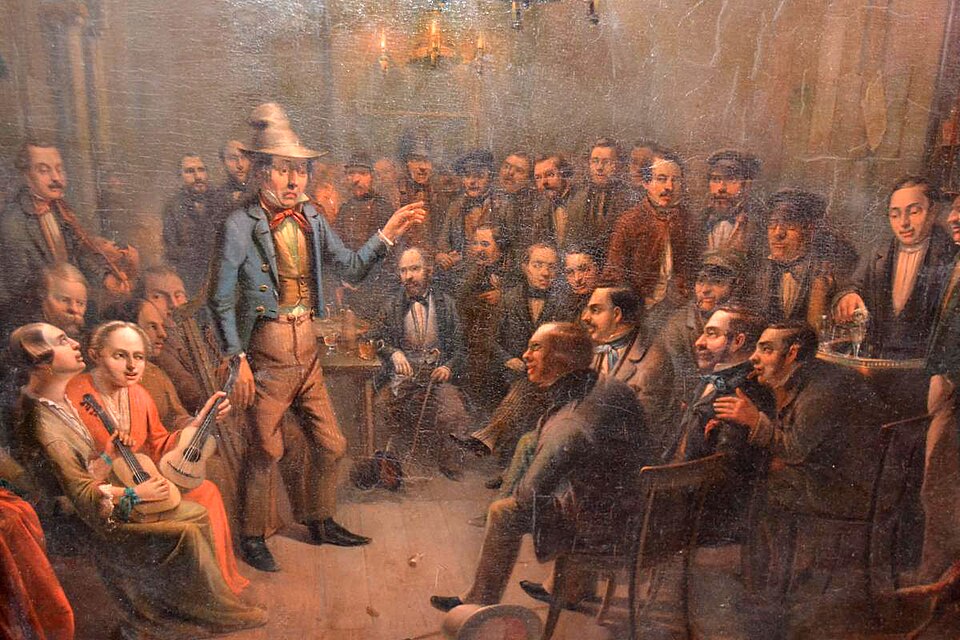
A story is never only about the person telling it. The Storyteller, Thomas van Leent (1807–1882). Public domain.
What Heron & Moss has changed is that I now realise how much of it stayed with me. The stories certainly, but also the expressions, movements, voices, faces, sounds, the way someone held their mouth when imitating somebody else, and all those little reactions taking place around the telling.
So when somebody says, “Tell them about the time…”, of course I listen to the story. But I suspect I’ve always been watching the room as well.
Stay with Heron & Moss
New stories about people, places, home, memory and the ordinary things worth noticing. A new story, occasionally.


Leave a comment