A Piseog About a Ciotóg
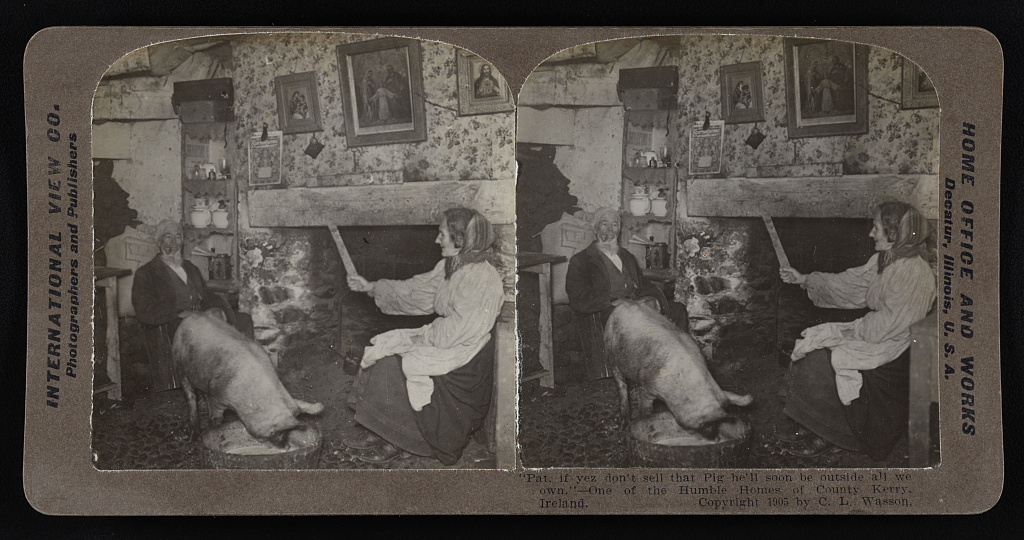
Inside a County Kerry home, c. 1905. Photograph by L. L. Wasson. Library of Congress — no known restrictions on publication.
Someone told me once that every ciotóg began as a twin. I have absolutely no idea who.
I don’t know where I was when I heard it, how old I was, or what we had been talking about that could possibly have led to it, only the strange little piece of information that there had been two babies at the beginning. One had apparently stopped developing very early in the pregnancy and the other continued alone. The child who was eventually born was left-handed — a ciotóg.
I don’t think I believed it, but I don’t remember thinking it was nonsense either. It was just odd enough to make me wonder, and apparently that was enough.
It was a piseog, of course, which gives me two words in the same story that I have no recollection of ever learning. I learned plenty of Irish words at school, from books and teachers along the way, yet nobody, as far as I can remember, ever taught me ciotóg. I just knew what one was. The same was true of piseog.
I find Piseog difficult to translate. Superstition comes close, and many piseogs are certainly superstitious. Old wives’ tale comes close too, particularly to the way some are handed from one person to another. But neither feels quite the same to me. Perhaps it is because both English expressions arrive with a judgement already attached. A superstition isn’t supposed to be rational; an old wives’ tale isn’t really supposed to be true. A piseog, at least as I have always understood the word, leaves the door slightly ajar. You can laugh at it, dismiss it, tell somebody else about it — and still find yourself wondering.
Irish folklore is alive with piseogs, most of them woven through the daily lives of the people who carried them. Milk and butter, births and deaths, animals and weather, journeys, visitors, fires, flowers, the threshold of a house. Milk wasn’t to be given away on May Day. Whitethorn blossom wasn’t to be brought indoors, although apparently leaving it at the doorstep could keep the fairies away. If the butter refused to come in the churn, one Kerry remedy involved a buttered green stone; another required a visit to a graveyard between midnight and one o’clock to acquire a dead person’s hand.
I think I’d have bought the butter.
The people themselves, though, strike me as anything but ordinary. There is an intelligence running through so much of Irish folklore that is difficult to describe: observant, imaginative, sometimes mischievous and deeply attuned to human nature. We seem to have had an extraordinary capacity to look at something commonplace and find another layer in it. You hear it in our turn of phrase and in the way the world could be read expansively — weather, seasons, birth, death, luck — and then microscopically, right down to our own doorstep.
Perhaps that is why the piseog about the ciotóg doesn’t feel entirely out of place. Somebody noticed something tiny: that one person reached for the world with a different hand. There must have been a reason for that too.
And somewhere along the line, the answer became twins.
That is the bit that still catches me. Of all the explanations available to a world already well supplied with fairies, omens, luck and curses, why explain a ciotóg by imagining another baby who had been there at the beginning and then disappeared?
And then there are the twins themselves.
Twins don’t necessarily favour the same hand. There are pairs where one is right-handed and the other left-handed, even among identical twins. I hadn’t known that when somebody first told me the piseog, and when I discovered it years later I found myself thinking about that missing twin again.
Perhaps I had been looking at the story from the wrong end. Suppose it didn’t begin with a twin who disappeared at all. Suppose it began with two who were very much there, growing up side by side, one reaching with the right hand and the other with the left.
Surely somebody would have noticed.
Whether any of that has anything to do with the piseog, I have no idea. Perhaps somewhere there really were twins, one right-handed and one left-handed, and people talked about them. That’s as far as I can take it without doing exactly what the piseog may have done in the first place — making an explanation out of something just because it seems to fit.
Then there is another curious detail. We now know that some pregnancies begin with more than one embryo and don’t continue that way. One can stop developing very early, sometimes before the mother even knows she was carrying twins.
A vanishing twin.
It doesn’t make the piseog true. But it leaves the old story sitting rather strangely beside two things we now know can happen: twins can favour opposite hands, and a pregnancy that produces one child can have begun with two.
Twins. Disappearance. Left-handedness. All three were there in a piseog told to me years before I knew anything about vanishing twins, or that twins could favour opposite hands.
That was the part I couldn’t quite shake off.
What I want to know is what came first. Was there once a pair of twins, one right-handed and one left? A birth somebody remembered? Or some connection made so long ago that the reason for it disappeared while the piseog carried on?
There is something unexpectedly beautiful in the thought that you write with your left hand because someone is missing, a small physical difference made into the trace of another life. Maybe that’s why the piseog stayed when everything around it disappeared. I can’t remember where I was, how old I was or even who told me. If I could find that person now, I wouldn’t ask whether it was true. I’d ask who told them.
Perhaps they wouldn’t remember either. Perhaps all they could give me would be the same two Irish words I somehow picked up without ever learning them — piseog and ciotóg — and an answer that has carried stories a lot further than this one.
They say.
Stay with Heron & Moss
New stories about people, places, home, memory and the ordinary things worth noticing. A new story, occasionally.


Leave a comment