A Town Gives Back
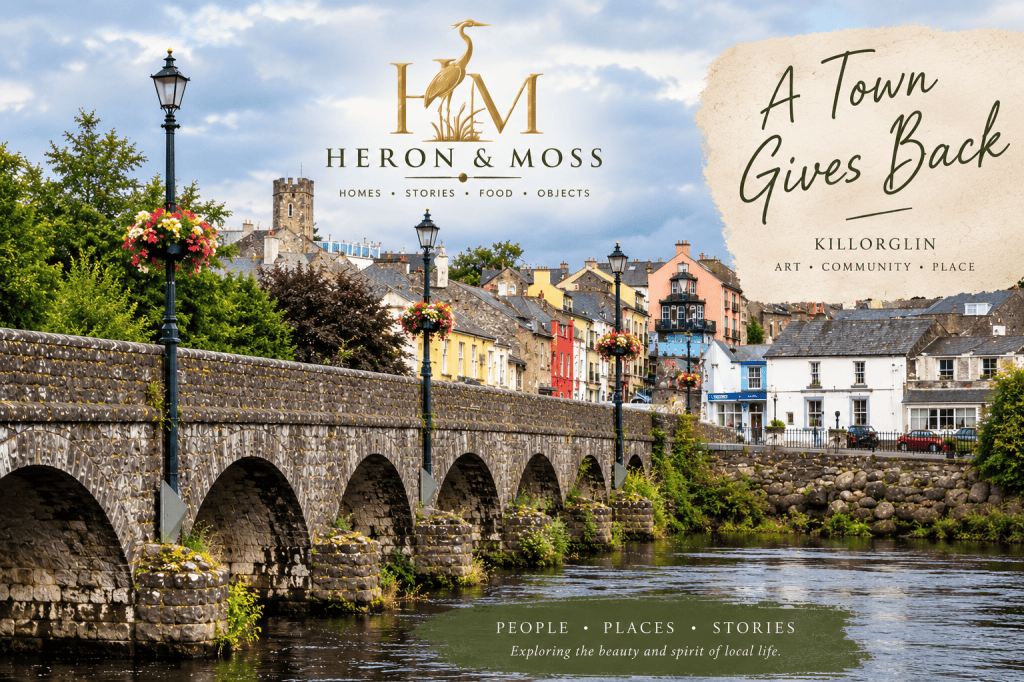
For one September weekend, K-Visual opened the doors of Killorglin, bringing art, conversation and new life into familiar streets and forgotten rooms.
On a September morning, the doors of Killorglin opened to paintings, sculpture, memory and conversation.
High above Upper Bridge Street, a blue cherry picker was stretched against the grey morning sky. Kerry artist James Hayes was up there, working on the side of Kingston’s Town House. Below him, Saturday morning carried on: cars moving through the town, people crossing the street, someone stopping every so often to look up.
On Langford Street, local Cromane artist Ava McKenna‘s mural was already finished. A black hare rose against a pale moon, three spirals above its head. Further out on Iveragh Road, a figure woven from willow stood outside Fexco, arms raised towards the sky. Inside, Ava was showing more of her work, talking easily to people as they came through, clearly happy with how her day was going.
I had come into Killorglin for K-Visual, thinking I would spend an hour or two looking around. Instead, most of the morning disappeared as I followed its trail through streets I have known for years and through doors I might otherwise have passed. Old shops, former banks, rooms temporarily filled with paintings, sculpture, film, willow, bronze, fibre and thread.
There was a looseness to it all that I liked. You went in somewhere, looked for a while. You talked to an artist, or to whoever happened to be standing beside you, then stepped back out onto the street and followed the signs towards the next place. The town was always there between the exhibitions: traffic passing, people meeting, shopfronts and upper windows, the river somewhere below, the hills beyond. Then another open door would draw you inside.
The artists themselves were very much part of the morning. They stood among the things they had made and talked about them without ceremony. Conversations started easily. People asked questions, others joined in, somebody laughed. There was none of that slight nervousness you can sometimes feel around contemporary art, when everyone seems to be waiting for somebody else to say what a piece means before risking an opinion of their own.
Willow had been bent and woven into human and animal forms, fibres and threads hung from walls, and paintings carried land, water and weather. On Langford Street, Ava’s black hare sat beneath its pale moon and three spirals. Much of what we were seeing was unmistakably contemporary, yet there was something older moving quietly through it too, in the animals and materials, the landscape and the stories, in things shaped and worked by hand.
It felt completely at home here.
On Lower Bridge Street, the old AIB had opened its doors as one of the exhibition spaces. I had been through them often enough when it was still a bank. This morning people were moving slowly through the rooms looking at paintings. Just inside the door was the work of Siobhán Moore.
One painting caught me almost immediately. I moved closer, walked away, came back and looked again. There was a landscape in it somewhere, but nothing definite, just layers of colour and the feeling of weather moving across land and water. Something about it was familiar before I understood why.
Then Connemara came into my head.
My father came from there. Our family holidays when we were children were spent in Galway, travelling out through Connemara with its lakes and mountains, stone, bog and Atlantic sky. Something in Siobhán’s painting had taken me back there, perhaps the colour or the light, perhaps just the feeling of that landscape stored somewhere from those holidays.
Whether Siobhán had painted anything remotely connected with Connemara didn’t really matter. That was where I had gone.
Siobhán was there beside her work. I didn’t ask her about the painting or what had inspired it. I already knew I liked it. I decided to buy it. The transaction took a little longer than expected when the Sum-up card machine decided not to cooperate at first, and we laughed our way through it until eventually it did.
There was something amusing about standing in an old bank, surrounded by art, trying to persuade a little card machine to accept payment for a painting.
The painting will come home to Glenbeigh when K-Visual is over.
Further along, another childhood memory was waiting.
Kitty Sheahan’s.
We used to go in there for sweets when we were children. Stepping through the door again brought the place back immediately. The long glass counter was still there. Behind it, shelves held cups and plates, old tins, religious pictures, a crucifix, a jug, a clock and the odds and ends that had settled there over time. Among them was a faded Cadbury sign.
I stood at the counter and could see Kitty behind it again, folding the paper around our sweets before handing the little cone across the glass.
Now there was art on the counter.
The shop hadn’t been emptied or tidied out for the occasion. The old shelves still held their bits and pieces, old relics rather than anything that would once have been for sale. The glass counter was still itself. The artworks had joined whatever was already there. My eye kept wandering from the exhibition towards an old cup or a religious picture, the Cadbury sign or something half hidden on a shelf, before returning to the work.
For me, Kitty was still behind the counter.
Back outside, the grey light had hardly changed. We followed the trail onwards. On Langford Street we went into the old Boyle’s Hardware shop.
Paintings occupied the walls, bronzes sat on white plinths, pale ceramic sculptural forms hung on long cords and pieces made from fibres and threads brought their own textures into the old shop. Further inside, the light dropped away. A film flickered across the wall of a darkened room, its changing glow falling across patterned carpet and wood panelling beneath an old-fashioned light fitting.
Somewhere in there I had started looking at the buildings almost as much as the exhibitions.
In the former Bank of Ireland on Market Street, an old three-shelf press stood among the work. On its top shelf were three old milk bottles filled with liquid and, unless this morning has already begun rearranging itself in my memory, I think there was a flower in one of them.
“Passed their sell-by date,” a woman behind me said.
I laughed.
I still don’t know whether she had read the title somewhere or had just given the piece a very good title of her own.
I turned around as she began looking at something on the bottom shelf, a darkened bronze form fixed to a piece of shiny aluminium. The metal reflected the underside of whatever it was we were looking at, which didn’t make identifying it any easier.
“Is that an elephant’s tongue?” she wondered.
“Probably a cow’s tongue,” I said.
“We had plenty of that when we were young.”
So had I. Cold in sandwiches, with salt and loads of pepper.
“I suppose you can’t get it anymore now,” she said. “Health and safety and rules…”
And off the conversation went, two strangers standing in the old Bank of Ireland talking about cow’s tongue sandwiches while a piece of contemporary art sat on the shelf in front of us, quite possibly representing something else entirely.
There had been plenty of conversations with artists during the morning. There were these little exchanges too. Someone commented on something, another person answered, and sometimes the conversation wandered off in a completely unexpected direction. Nobody seemed too concerned about having the correct interpretation.
The hours went that way, from room to street and street to room. Somewhere along the way I began taking photographs, first of the art and then of almost everything else: Kitty Sheahan’s glass counter, windows and doorways, people standing talking, James Hayes high above Upper Bridge Street, Ava McKenna’s hare on Langford Street, the willow figure reaching upwards outside Fexco.
Eventually, with most of the morning gone, I wandered into the Bianconi. I ordered a chilled glass of New Zealand Sauvignon Blanc, my usual, and sat there for a while with the cold glass in front of me and the morning still moving around in my head.
By then I had bought a painting, remembered Kitty Sheahan’s paper cones, been carried back to Connemara and discussed cow’s tongue sandwiches with a woman I had never met before.
Not bad for a morning looking at art.
I’m home in Glenbeigh now, going through the photographs as I put this piece together. What surprises me is how many of them are of Killorglin itself.
There were the old shops and banks, the counters and shelves, the windows, doorways and walls, rooms I had never entered and buildings I had passed countless times.
Tomorrow much of what I saw will begin to disappear. Paintings will be wrapped, sculptures moved and projectors switched off. James Hayes’s mural will remain on Upper Bridge Street, as will Ava McKenna’s black hare beneath its pale moon on Langford Street.
Siobhán Moore’s painting will be coming home to Glenbeigh.
And I think I’ll leave it there.
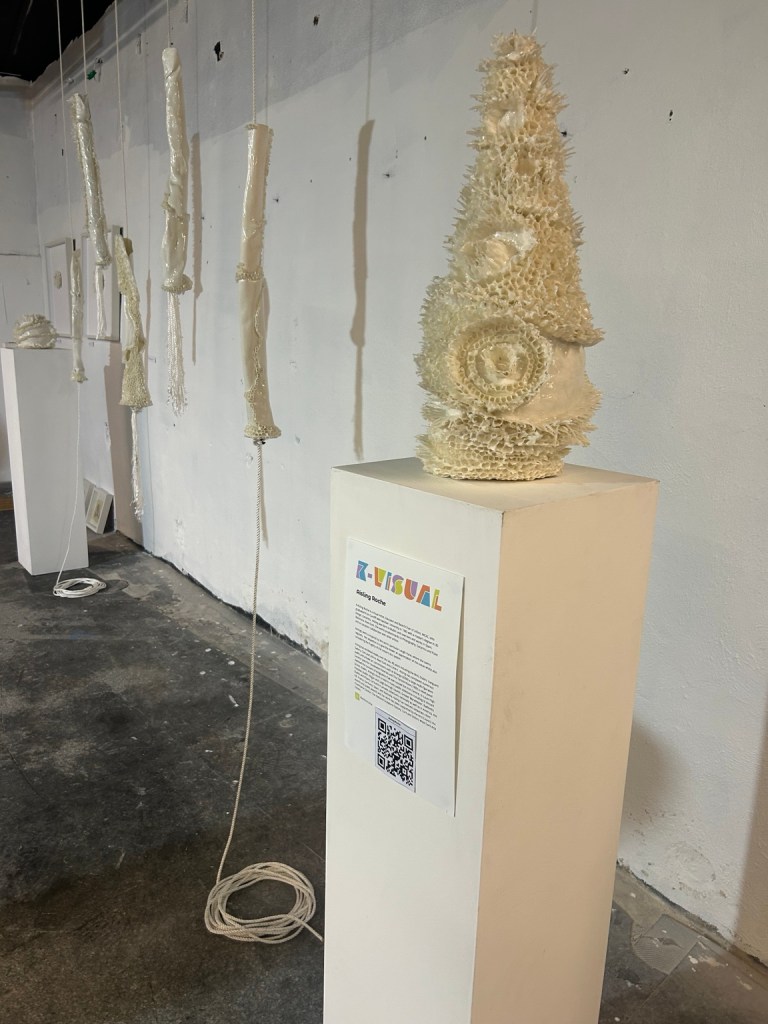
Pale, intricate forms hang and rise through the old Boyle’s Hardware shop on Langford Street K-Visual 2026.
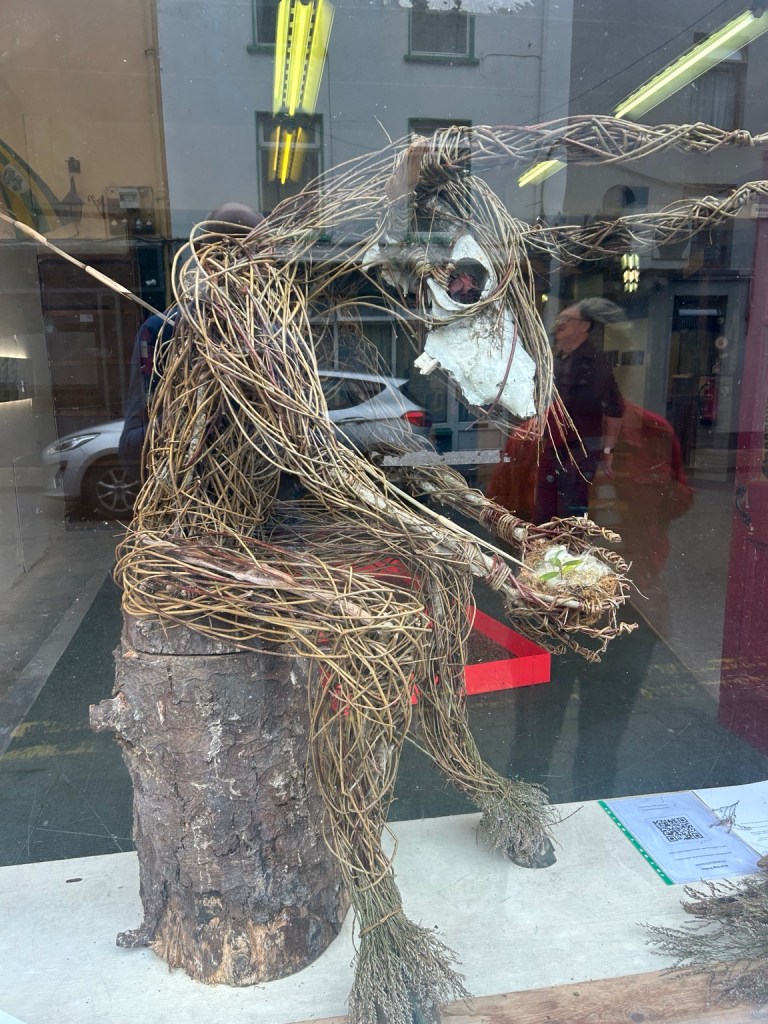
Willow, wood and imagination — a quietly strange figure sits in a Killorglin window, holding something green and growing in its hands as the town becomes part of K-Visual
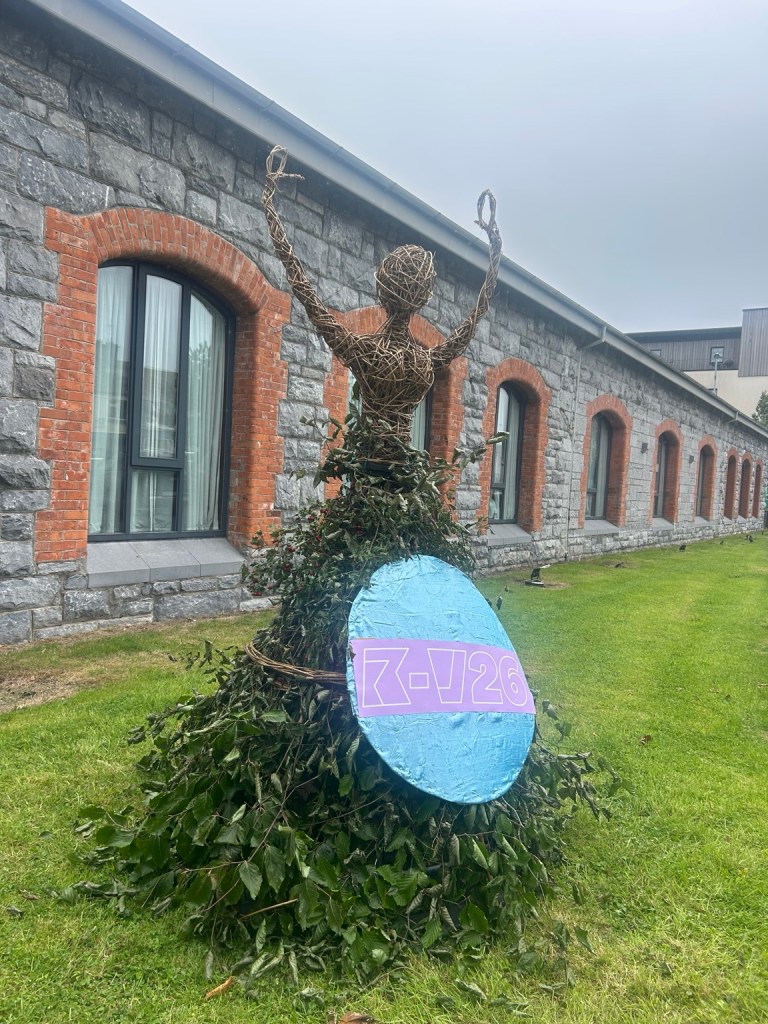
A willow figure reaches towards the sky outside Fexco, one of the more magical encounters along the K-Visual trail.
There are stories everywhere — in old shops, familiar streets, the things we keep and the memories that return when we least expect them. Heron & Moss is about noticing them.
If you’d like the next story to find its way to you, you’re very welcome to join us.


Leave a comment