The Gift OF A Story
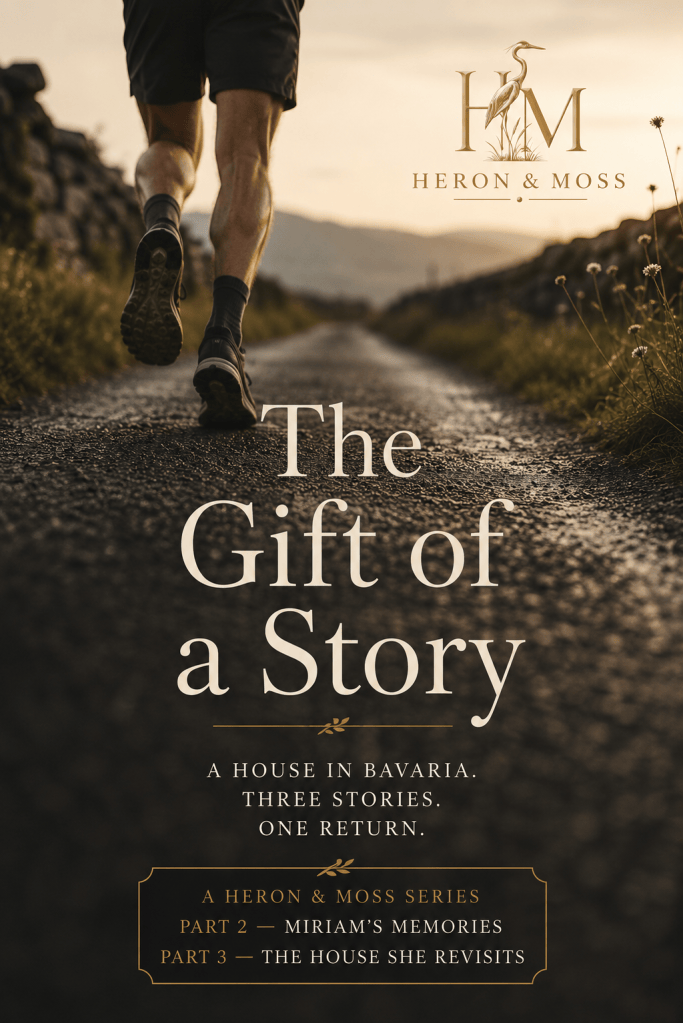
A road like the one that led, eventually, to a house in Bavaria.
Since beginning Heron & Moss, I have become much less certain about where stories come from. I used to think you went looking for them. You chose something worth writing about, did whatever research was needed, sat down and began. It hasn’t really happened like that. More often, I seem to come across them. A smell can do it, or an object I have passed hundreds of times without giving it much thought. Someone says a sentence and, for reasons I don’t immediately understand, I am still thinking about it later. A place I haven’t thought about in years can return because of something I see through the car window on the way home. I am learning not to dismiss those moments quite so quickly, because sometimes, if I stay with them for long enough, I begin to see where they might lead.
There is another way a story can arrive, and I am beginning to think it might be the best way of all. Somebody gives you one.
That happened after run club one Sunday morning. I had known Miriam for a while, although “known” is probably stretching it. We knew one another well enough to say hello when we met, as you do with so many people whose lives cross yours regularly without either of you ever quite getting beyond that. Her husband Markus and their son Benjamin run too, and after Sunday’s run the four of us got talking. Miriam asked me about Heron & Moss, what had started it and what else I hoped to write about. It is a question I still find surprisingly difficult to answer. There are subjects I know I would like to explore, but the longer I do this, the less inclined I am to make a list of them. I think I need to leave some room for the ones I haven’t thought of yet.
I told Miriam that I had been thinking about rooms — not interior design, but the rooms we can still enter in our heads years after we last stood in them. There are houses from my own life that I can still move through. I know where a table stood and which chair somebody always chose. I can see a door handle, a bed, a particular window. I can remember the smell of a room more readily than I could tell you how big it was. There are places I could probably walk through now, reaching for doors that are no longer there. I wondered aloud how many of us have houses like that, still furnished somewhere in our heads even though we may not have seen them for decades.
Miriam didn’t have to think for very long. She had one: her grandparents’ house in Bavaria.
From there the conversation went somewhere I hadn’t expected. Miriam told me a little about the place where she had grown up, a small Catholic village in Bavaria where grandparents, aunts and uncles lived close by and played a large part in one another’s lives. Families knew families. Tourism mattered there too, although she said the tourism she remembered was quite different from what she knows now in Glenbeigh. At one point she said, “You know, it was actually quite like Glenbeigh,” and that caught me. The landscape was different, of course, as were the language, the houses, the food and the weather, but I understood the comparison she was making. Glenbeigh is also a place where family connections have traditionally stretched beyond one household. Ask who somebody is and the answer can still involve a parent, an uncle, a marriage, a grandparent or the house where the family once lived. Miriam was describing somewhere a long way from Kerry, but the way people fitted into the place sounded strangely familiar.
Then she told me about the house. Her uncle inherited her grandparents’ home in the late 1990s and later built a new house on the same grounds, but the older house was left standing. Some possessions may have been taken by members of the family over the years, but Miriam believes that much of it remains as she remembers it. And in November she is going back.
We were still standing there after a Sunday morning run, but somewhere along the way I had become completely caught by a house in Bavaria I had never seen. When I had put on my runners that morning, I hadn’t known Miriam had grown up there, hadn’t known about her grandparents, hadn’t known there was an old house still standing on the same ground all these years later. Half an hour earlier none of this had existed for me, and now I wanted to know what was behind the door.
What interested me wasn’t only what Miriam might find when she returned — it was what she thought she would find. Once she goes inside in November, what she remembers and what she sees will begin to mix. A room she has carried one way for years will be corrected by the room in front of her. A room she has carried one way for years will be corrected by the room in front of her. Something she is certain was there may not be there at all. If there is a story in the difference between the house Miriam remembers and the one that is actually standing in Bavaria, I would like to hear about the first one before she opens the door.
So I asked whether, before she goes back, she might describe the house entirely as she remembers it. No photographs, no checking with family, no attempt to establish whether the kitchen really was that colour or whether the cupboard really stood against that wall. I can give her a few questions to begin with, but after that I think I should stay out of the way. She knows which parts of that house have stayed with her. I don’t.
That will become Part Two. Miriam will tell us about her Bavaria, the village, the people who were there, her grandparents and the house she can still see in her head. We will put those memories down before she goes and leave them exactly where she puts them. If she remembers a chair beside a particular window and an old photograph would prove otherwise, I don’t want to see the photograph. For now, the chair stays where Miriam remembers it.
Then, in November, she will go back.
That will be Part Three.
By then we will know the house Miriam has carried with her. What we cannot know is what it will be like to stand inside it again. Perhaps she will be surprised by what has changed, perhaps by what hasn’t. She may find what she goes looking for, or it may be something she hasn’t mentioned to me at all that brings her back. There is no point deciding any of that now. We will let Miriam go home and see what happens.
I have thought about Miriam differently since that Sunday morning. For all the times we had said hello, I knew none of this about her. I suppose that is true of most of the people we pass regularly. We know the version that belongs to the place where our lives happen to cross. Behind that there are houses, grandparents, childhoods, places left behind and stories we may never hear unless a conversation happens to go a little further than usual.
Ours did.
I didn’t go looking for any of it.
Miriam gave me the story.
“Part Two comes before Miriam goes back. Part Three comes after. If you’d like both, subscribe below.”


Leave a comment