The Slackening Lead
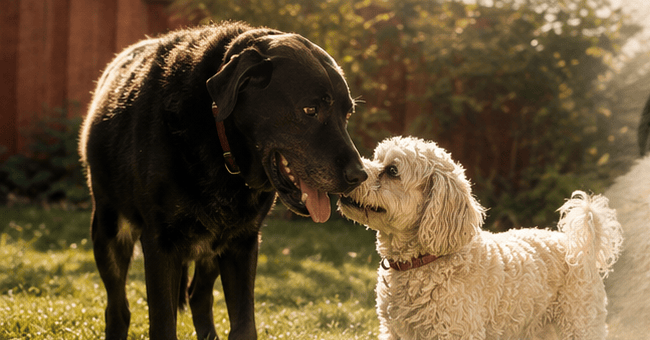
Rosie and Frasier during their year together
There was a time in Ireland when a dog could be dearly loved and still be expected to know that it was a dog.
I grew up with them. They belonged to the house without necessarily belonging in it, sleeping in sheds, garages, kennels or back kitchens, eating whatever was left over from dinner and scratching at the door to come in, only to scratch at it again three minutes later because they had changed their minds.
They were everywhere in family life all the same. They followed children down fields and roads, turned up at football matches nobody had brought them to, recognised the sound of the family car long before it came into view and knew which visitor warranted a bark and which one barely deserved the lifting of a head. They were guards, playmates, companions and occasional pains in the backside, and I can’t remember a time when there wasn’t a dog around somewhere.
At some point between those dogs and the small Cavachon who now exercises considerable influence over our household, things changed.
His name is Frasier. He came to us almost nine years ago, bought originally for one of our daughters. At the time we already had Rosie, a rescue dog, a mongrel who was mostly Labrador and had been with us since the girls were toddlers. Rosie lived until she was sixteen and seemed to spend much of that time under the impression that the children had been entrusted specifically to her care.
She took the responsibility seriously, tagging along whenever she could. Looking back at photographs from those years, I notice her now in places I probably didn’t notice her then: lying in the background, standing at the edge of something, following behind. Wherever the girls were, Rosie was never very far away.
Frasier and Rosie had about a year together before she died. By then she had been with us for most of the girls’ childhood, which made losing her terribly hard. Sixteen years is a fair chunk of a family’s life. A dog can arrive when children are small enough to need help putting on their shoes and still be there when those same children are nearly grown.
Rosie, for her part, had to get used to him. Frasier was young and constantly trying to play with her, while for a time she seemed to regard him as either an imposter or a nuisance she hadn’t asked for. Gradually she came round to him. Every now and then, despite her years and slowing joints, Rosie would give in and chase him around the garden. I still smile when I think of it — old Rosie briefly forgetting herself, Frasier delighted that he had finally persuaded her to play.
When Rosie went, the house felt emptier.
Frasier was our first proper indoor dog, a distinction our daughters still use against him.
“Frasier, remember when we had a real dog?”
Over the years dogs have come in from the yard, got comfortable in the kitchen and eventually found the sofa. I suspect plenty of them have made it as far as the pillow by now.
Living that closely with a dog changes things. When I was small, an aunt used to say of her Jack Russell that he could nearly talk to you. I used to laugh at her.
I don’t anymore.
Frasier can nearly talk to us.
After years together, you know what they mean. A stare held for slightly longer than usual. A sigh. A head on a knee. A particular position at the door. The sudden appearance in the kitchen of a dog who, seconds earlier, appeared to be deeply asleep somewhere else.
He has us fairly well worked out too.
Certain words can no longer be spoken freely. Walk. Beach. Cat. We began spelling them.
“Will we take him for a W-A-L-K?”
This worked very well until Frasier learned to spell. Or, more likely, realised that when the two humans began communicating in individual letters, something worth getting excited about was being discussed.
My sister-in-law thinks we’re nuts, which naturally makes us worse whenever she calls. She arrived recently to go walking with Claire and Claire asked her to wait while she got some tissues.
“Surely ye don’t wipe his backside?”
We don’t, of course. Claire just hates the feel of picking up Frasier’s poo through a plastic bag, so she uses a tissue as well. I could have explained that.
Instead, I told her they were out of the scent-free wipes in the shop.
You have to take your entertainment where you find it.
When the girls went off to college, Claire and I found ourselves alone as a couple again. After all those years of school, lifts, meals, friends calling and the girls around the house, it was just the two of us again.
Except, of course, it wasn’t.
Frasier was still there.
The dog who had been bought for our daughter had become ours. Worse than that, if I’m going to be truthful, he became what I once would have rolled my eyes at hearing somebody call a fur baby. There was no point pretending otherwise.
I doubt we’re unusual. There are dogs sleeping tonight in houses where the children have grown and gone, dogs beside people who live alone, beside couples, young families and old ones. Dogs waiting at windows for somebody to come home, following somebody from room to room for no better reason than that is where their person happens to be.
The dog outside the back door could be loved every bit as fiercely as the dog now stretched across the sofa. Rosie was. But somewhere along the way the boundary moved and the dog came further in.
Frasier certainly has.
He knows our routines better than we probably realise. He can tell the difference between someone pottering around the kitchen and someone getting ready to go out. He seems to know before we do when there’s a chance he might be coming too.
And then there is the welcome home.
You can be gone for ten minutes and Frasier greets you as if your return is the best thing that has happened all day.
This summer, though, something has changed.
Frasier has always been a devil for pulling on a walk. For years we have been behind him, trying to persuade him that there is no desperate urgency to reach the next bend, that the beach will still be there, that every smell does not have to be investigated immediately.
This summer, for the first time, there have been walks where, after a few kilometres, it is we who are gently pulling him along.
Sometimes when we get back, we have to lift him into the car.
If I’m honest, it frightens me a little. Frasier is almost nine. I know perfectly well that he isn’t a puppy, but in some corner of my mind he still is. Perhaps dogs stay young in our heads in much the same way our children do. You look at them and still see what was there before.
So there is cod liver oil going into Frasier’s dinner now. We gave it to Rosie when she was old, and it seemed to work wonders for her joints. For a while she moved more freely again. All these years later, out came the bottle for Frasier, a little poured over his food each day in the hope that it might do for him what it once did for Rosie.
Frasier never chose our house. He didn’t choose Claire or me, the girls, the food we give him, when he gets walked or where we take him. We decided all of that for him.
And yet this became his home.
Wherever we are is still, almost always, where he wants to be. If you get up, he gets up. Move to another room and, before long, he will probably appear there too. Pick up the car keys and he wants to know if he’s coming.
We are not always deserving of the welcome he gives us in return. We get impatient, leave him behind, put off the walk, get annoyed at the barking, the wet paws, the hair. A few minutes later he’s beside us again looking for a rub, as if none of it happened.
He has spent most of his life waiting for us: to wake up, to open the door, to come home.
And when we finally appear, he still behaves as though we are the ones who have done him the favour.
So now, every so often on a walk, he is the one who needs us to wait.
We walk a little more slowly.
And if he needs lifting into the car, we lift him.
Tomorrow someone will accidentally say “beach” and all evidence of advancing age may disappear as he loses his mind at the possibility.
Stay a little longer.
Heron & Moss tells stories about homes, people, places and the ordinary things we carry with us.
If you’d like the next story to find you, you can subscribe below.


Leave a comment