Anseo
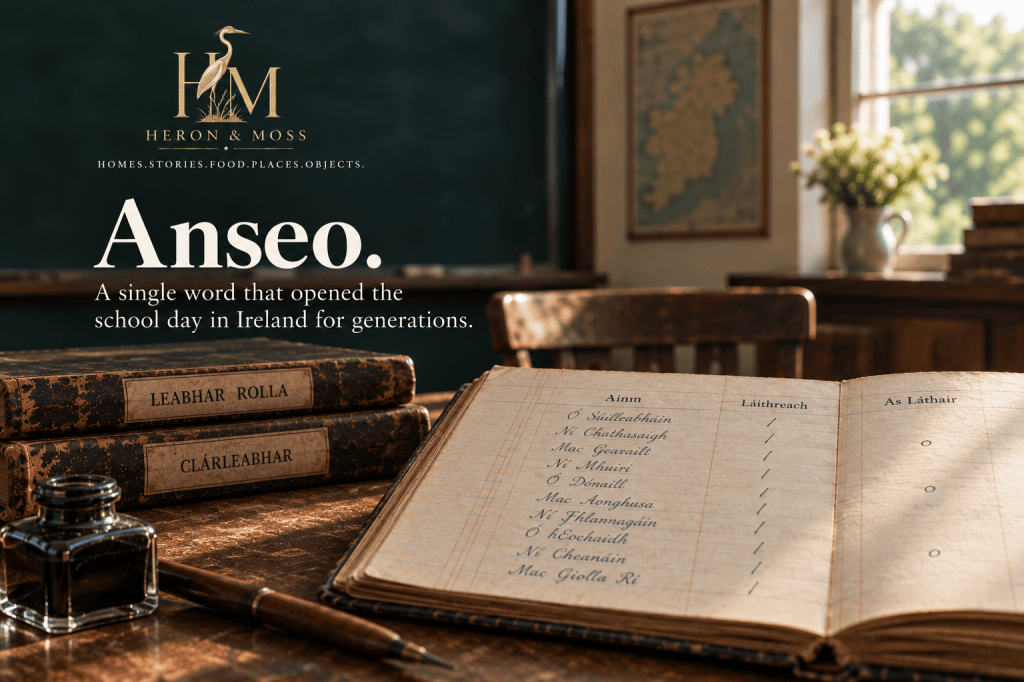
Anseo — remembering the roll books that recorded generations of Irish schoolchildren.
“Anseo.”
Here.
That word opened the school day in classrooms across Ireland for the better part of a hundred years.
For the first half of my teaching career, and for a little longer, that call belonged to a book on the desk, a Leabhar Rolla. It was rarely a new book. It belonged to the classroom and passed from one teacher to the next. By the time it reached you, its covers might be worn and its pages softened by years of handling. Earlier names belonged to children who had already left the school, some in secondary school, others working or living abroad, a few beginning to return to the school gates as parents.
If somebody was missing, the answer came from the rest of the room, almost in unison.
“As láthair.”
Absent.
Only then were the explanations offered.
“He’s sick, Sir.”
“She’s gone to the doctor.”
“I didn’t see him on the bus.”
The absence was marked and the next name called.
It was one of several such books, each depending on the accuracy of the one before it, the Leabhar Rolla for the day-to-day count, the Clárleabhar holding each pupil’s permanent record, the Leabhar Tinrimh Laethúil gathering the school’s daily figures into one place. A child present was marked with a diagonal stroke, a child absent with a small circle, one for every child, every day. At the end of the week the figures were totalled and sent to the office. Then came the quarterly totals, usually completed on the final day before a school holiday.
That was when the trouble started.
No matter how careful you had been, it was easy to find yourself out by one or two. You counted the marks again. You checked the dates, the weekly totals, the number of children on the roll. Perhaps an absence had been entered incorrectly. Perhaps a line had been missed or a column counted twice.
You went through it again and again. The mistake only burrowed deeper.
The children, meanwhile, had gone home. The half day was theirs. The teachers stayed behind until every figure balanced, and the school that had been full of excitement that morning grew quiet, apart from the turning of pages, the tapping of calculators, the occasional sigh from a classroom where the numbers still refused to agree.
Then a cheer would come from somewhere along the corridor.
Someone had balanced.
That teacher was now officially on holiday.
We had one colleague who was our saving grace on those afternoons. She had a gift for finding the missing number after the rest of us had hit a brick wall. She would take the book, look down through the columns and, more often than not, find the error almost at once — a mark overlooked, a total carried forward wrongly, one child missed from the count. It had remained invisible to everybody else. There was great relief in seeing her appear at the classroom door.
The same care applied to what was written in the books as to the figures they contained.
Children’s names were entered in Irish, and now and again a family arrived with a name that had no obvious Irish form. There might be several possibilities and no certainty about which one to use. Dictionaries were consulted, colleagues asked, older records examined. The space could not be left blank. The name had to be found and entered properly.
It showed, too, in the handwriting. Names ran across the pages in the careful hands of teachers who had left the school years before. What stayed with me was the calligraphy itself, how beautiful it was, the discipline of it, the sense that a child’s name deserved a steady hand and enough time to write it properly.
The roll book recorded the children. It held something of the teachers too.
In my final school, one wall of the archive room was taken up almost entirely by old roll books. The Sisters had covered them in leather to protect them, practical work that gave the books an unexpected weight. They stood in rows, dating back to the foundation of the school in 1890, holding the names of generations of children who had passed through the school, and they did not look like paperwork that had outlived its usefulness.
The archive contained another book recording the teachers who had served on the staff: the year each joined, when they qualified, when they became permanent.
My own name is there now, one entry among the Sisters and the lay teachers who followed them. I did not think of it as history when I signed it in. I think of it that way now.
The roll books are no longer used in the daily life of the school. Attendance is recorded electronically, and the old books survive now as archival records, though they are still opened from time to time. A request might arrive from somebody abroad tracing a relative, and the answer could be in one of those books: a name, a date of birth, a home address, the year a child entered the school. Local-history projects have found grandparents and great-grandparents in the same pages, the same surnames turning up generation after generation, a name a child recognised, written by a teacher neither of them had known.
You could hold the history in your hands. There was the grain of the leather, the dry paper, the ruled columns. The handwriting changed as one teacher succeeded another. On some pages, the pressure of the pen could still be felt from the other side.
When attendance moved to Aladdin, the school’s data-management system, the weekly and quarterly figures could be totalled in seconds. There was no danger of spending the beginning of a holiday searching for a missing one or two.
It will never have worn corners.
It will not preserve the slope of a teacher’s writing or the care taken over an unfamiliar Irish name. No child will run a finger across its screen and feel the mark left by a pen many years before. Nothing in it will show the leather, fitted by hand, that protected books still being used every day.
None of them knew how long the books would last: not the Sisters, not the teachers who filled their pages. They were keeping the attendance, checking the totals and getting on with the work of the school.
For generations of people who attended school in Ireland, childhood has left behind this one official trace. Long after copybooks were thrown out, uniforms passed down and school photographs misplaced, the name remained on the roll.
Somewhere, perhaps only a few miles from where you live, the book that held your class may still be standing on a shelf. Open it at the right page and there you are, written in the hand of a teacher who called your name each morning and waited for your answer.
Anseo
Stay a little longer.
If Anseo brought you back somewhere, subscribe to Heron & Moss for new stories of homes, places, food, objects and Irish life, delivered directly to your inbox.


Leave a comment