The Pound in the Drinks Press
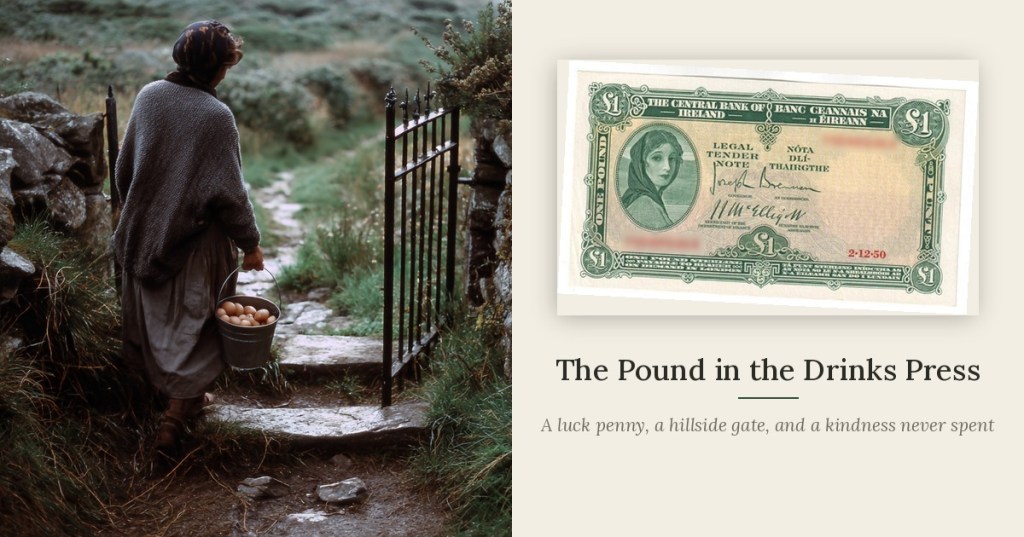
She never came down the hill empty-handed.
The Dutch oak unit in our living room was where everything seemed to find a home. It was deep across the bottom and narrower above, with a sliding door for the television on the left, open shelves through the centre and, to the right, a drop-front press made for drinks. Letters and important papers filled it instead. It never stayed tidy for long.
One day, clearing it out, I found a green pound note among them.
The explanation was brief. The site for our house had been bought from Danny and Breegie Moriarty in 1971, the year I was born. When the sale was finished, they handed a pound back for luck. The note was put away and never spent.
Luck money was part of the old courtesy of buying and selling in rural Ireland. At a fair or in a farmyard, buyer and seller might bargain hard before agreeing a price. The money was counted, hands were shaken and then a little of it was returned. A coin, a few shillings, sometimes a note. People called it the luck penny. Even an animal leaving one holding for another took with it something more than itself: the goodwill of the person who had owned it before.
Danny and Breegie brought the custom to the sale of a piece of ground.
They lived farther up the hillside behind our house. For years afterwards, Breegie would appear at the small gate at the back of the garden, a galvanised bucket resting against her leg. There might be a bottle of milk, eggs gathered that morning or potatoes still carrying the earth. She had no particular reason for calling. She had been about her day’s work and had thought of us in the middle of it.
She never came down the hill empty-handed.
The pound came from the same place. It belonged to the beginning of a house, when there was only the site and the building had yet to rise from it. In 1971, a pound was worth having. It could have bought groceries, petrol or something needed for the new home. Instead, it was placed among the papers.
The note held an older Ireland in its design. Large and green, it belonged to the first series of Irish banknotes, designed for the Free State and still being issued four decades later. Its promise to pay the bearer in London was printed in Irish and English. Lady Lavery appeared on the front, a shawl drawn over her hair, representing Cathleen Ní Houlihan, Ireland in the figure of a woman. The reverse held the carved head of the River Lee, taken from the Custom House in Dublin, its beard falling like water. In the pale circle beside it, hidden within the paper and waiting for the light, was the head of Erin.
Its place in the drinks press suited it. The papers around it recorded names, signatures, measurements and boundaries. The pound recorded nothing. Once it was returned, it was no longer one pound among all the others in circulation. It was the pound Danny and Breegie had given for luck.
Years later, the old notes were withdrawn and, in time, the euro replaced the pound. The green note stayed where it was, safe among the letters and documents that had gathered around it.
Last year, when I collected a new car, the dealer had a gift bag for me. Inside were Molton Brown soaps and conditioners, travel mugs and air fresheners. They were modest things beside the price. In all my years of buying cars, no dealer had given me anything before.
The car had been paid for, the forms completed and the keys handed over. The bag came at the end, freely given, and it pleased me more than I expected.
It was on the drive home that I thought of the pound note.
The payment for the car had moved invisibly from one account to another. No notes had been counted out on a desk. There was no particular euro that could be taken from the sum, folded away and remembered as the one returned that day.
The gift bag rested on the passenger seat.
It had passed from one person to another. It could be brought home, opened and remembered. The soaps would be used, the mugs taken on journeys and the air fresheners would lose their scent.
I am fairly sure the note is still there among the untidy papers, Lady Lavery looking out from the green paper and Erin hidden inside, waiting to be held to the light. I can see Breegie coming down the hill towards the small gate, the galvanised bucket against her leg, carrying whatever she had thought to bring that day.
Their kindness has never been spent.
Thank you for reading. Heron & Moss is where I write about home, memory, food, objects and place, and the people who shaped them. If you’d like to follow along, subscribe and each new essay will arrive in your inbox, like a neighbour at the back gate with something to share.


Leave a comment