The Photograph in the Envelope
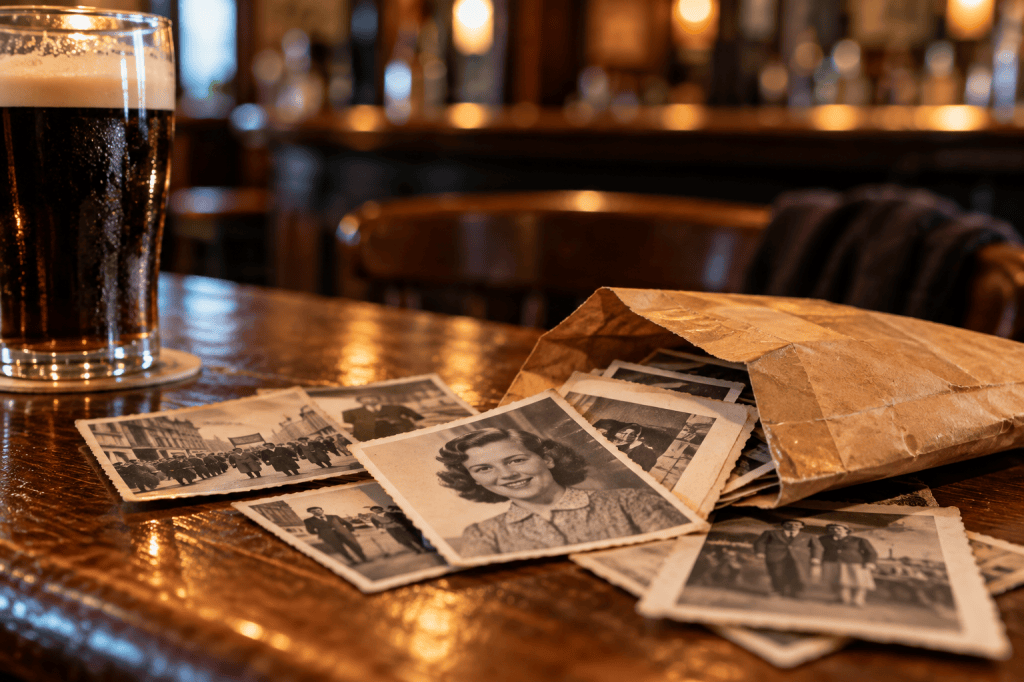
A brown envelope, a handful of photographs and the stories attached to them.
I went out for a quiet pint, happy to sit alone at the counter. Being out of the house was company enough.
Over the evening, I caught scraps of conversations from people who had nothing to do with one another. Someone was trying to get his heating fixed. At another table, old photographs were being passed around. I heard part of a story about a march during the hunger strikes, and later, a conversation about a will.
On the way home, I put the fragments together. I gave the voices names, brought them to the same counter and let them talk. Mick, Tom and Nora are invented. This is the story I came home with.
Mick arrived carrying a brown envelope under his arm.
“Any heat in the house yet?” the barman asked.
“There’s heat in here. I was thinking of moving in.”
He sat two stools down from mine and laid the envelope on the counter. The barman put a pint in front of him.
Tom came in a few minutes later. I gathered he was meeting Mick at the house in the morning, when a man was due to look at the heating.
“It could be the control box,” Mick said. “I’ve seen it go before.”
“You said it could be the wiring.”
“It could. That’s why I want them to look properly.”
Tom hung his coat on the back of the stool.
“If you open the wall where I showed you,” Mick went on, “they’ll get at the pipe without draining the whole system.”
“I’ll be there in the morning.”
“You said that.”
“And I’ll say it again if it helps.”
Mick took a drink.
His daughter, Nora, arrived while they were talking and sat beside him. He pushed the envelope towards her.
“Found these looking for the heating papers.”
She drew out a handful of photographs. I couldn’t see the faces, but I could see her turning each picture over to check the back.
“Who’s this?”
“Your grandmother.”
“I know her. Who’s beside her?”
Mick leaned in.
“Her sister, I think.”
“You told me she was a cousin.”
“Did I?”
Nora put the photograph to one side. Soon there were little piles between the glasses.
Every few minutes Mick looked towards the envelope. Nora noticed.
“Is there one missing?”
“I’m looking for it.”
“What one?”
“I’ll know it when I see it.”
One picture brought back a dinner dance. Mick remembered a man who could waltz so well that everybody else stopped to watch him. Another showed a young footballer who had been told to choose between playing and music.
“He chose music,” Mick said.
“Did he regret it?” Nora asked.
“I never asked him.”
Tom’s phone lit up. He glanced at it and told Mick the heating man expected to be there before ten.
“I’ll meet him,” Mick said. “I want to show him where to open the wall.”
Nora held up another photograph. Mick recognised a man in it through his father’s family. Tom thought he knew a story about him, though the two of them disagreed over whether it concerned that man or his brother. It went back to the Civil War.
“You told it differently the last time,” Tom said.
“Then I might have had it wrong.”
“Can I put a name on the back?” Nora asked.
“Leave that one for now.”
She set it down without writing anything.
Tom asked whether politics had been talked about much in Mick’s house when he was young.
“Not mine,” Mick said.
He had worn a lily openly, but his parents had not known where he went or whom he met. For a time, a detective followed him and brought him in for questioning.
“What did he want?” Nora asked.
“That depended on the day.”
Mick picked up another photograph, looked at it and laid it down again.
He began talking about the hospital where he had worked during the hunger strikes. There had been strong support for the prisoners among the staff. After one of the hunger strikers died, Mick was told he would lead the workers on a march.
“Why you?” Nora asked.
“I must have been near the gate when they were looking for someone.”
A banner was put into his hands as they set off. He remembered the words on it: Free the Hunger Strikers.
He walked ahead of the hospital staff. Farther along the road, men in black balaclavas appeared behind them.
Then shots were fired.
Tom turned towards him.
“You knew they were coming?”
“Nobody told me a thing.”
Mick said he had thought of Maeve and the children. He wondered if he would get home to them, or if he might be arrested. He remembered going over prison sentences in his head as he walked. Ten years. Twenty. Life.
“What did you do?” Nora asked.
“Kept walking.”
When he got back to the hospital, he went looking for the men who had sent him out.
“I asked them why nobody told me.”
“What did they say?” Tom asked.
“Nothing worth repeating.”
Photographs of the march went around for a while afterwards.
“Have you any of them?” Tom asked.
“Not in that envelope.”
Nora asked whether he regretted taking part.
“Not one bit at all.”
She lifted the next photograph. Mick named the women in it, including Maeve. One of the others had a laugh you’d hear across a hall.
“Maeve was great fun,” he said.
They had run away to Dublin to marry when they were young and had hardly any money between them.
“How long were ye married?” Tom asked.
“Fifty-six years. Or fifty-seven.”
“Fifty-seven,” Nora said.
“She’d have known.”
Nora laid Maeve’s photograph beside her glass.
Tom asked what Mick had decided to do with her ashes. She had loved her father, Mick said, and would go back to his grave. He planned to keep a small part of her ashes to take with him when his own time came.
“You’ll keep them at home until then?” Nora asked.
“I’ll keep her,” Mick said. “She loved me.”
The barman came to collect an empty glass, and they shifted the photographs to give him room. When he had wiped the counter, Nora put them back.
“Did you make the will?” she asked her father.
“I’m going to.”
“You said that when you came out of hospital.”
“I meant it then.”
He told Tom about a night when he had felt unwell and, by morning, could hardly get out of bed. At the hospital they took blood and put him through a scanner. He came home with tablets. While he was waiting to find out what was wrong, he had thought about the house and how he wanted to leave it.
“Equal between the two of you,” he told Nora. “I don’t want arguments.”
“We know. You have to write it down.”
Tom finished his drink. He and Mick agreed again on the time for the morning. Before leaving, Tom asked where he wanted the wall opened.
Mick showed him with his hands.
Nora began returning the photographs to the envelope. She kept a few out to take home and asked Mick to check the names she had written on their backs.
On one, he crossed out a name and wrote another. He looked at the picture once more, then crossed that out too.
“I’ll ask your aunt,” he said.
“Did you find the one you were looking for?”
He checked the few still lying on the counter, then looked into the envelope.
“No. It must be at home somewhere else.”
“Do you know who’s in it?”
“I thought I did.”
Tom had gone, and Mick’s pint was nearly finished. Nora folded the top of the envelope and put it beside his glass.
Maeve’s photograph was still lying on the counter.
“Mam,” she said.
Mick picked it up. He turned it over.
There was nothing written on the back.
He looked at it for a moment, then slipped it into his coat pocket.
Enjoyed this story?
Heron & Moss is a collection of stories about people, places, homes, food and the details that make one story different from another.
Subscribe to have each new story delivered straight to your inbox./sub


Leave a comment