Never Serve Stroganoff to a Caretaker
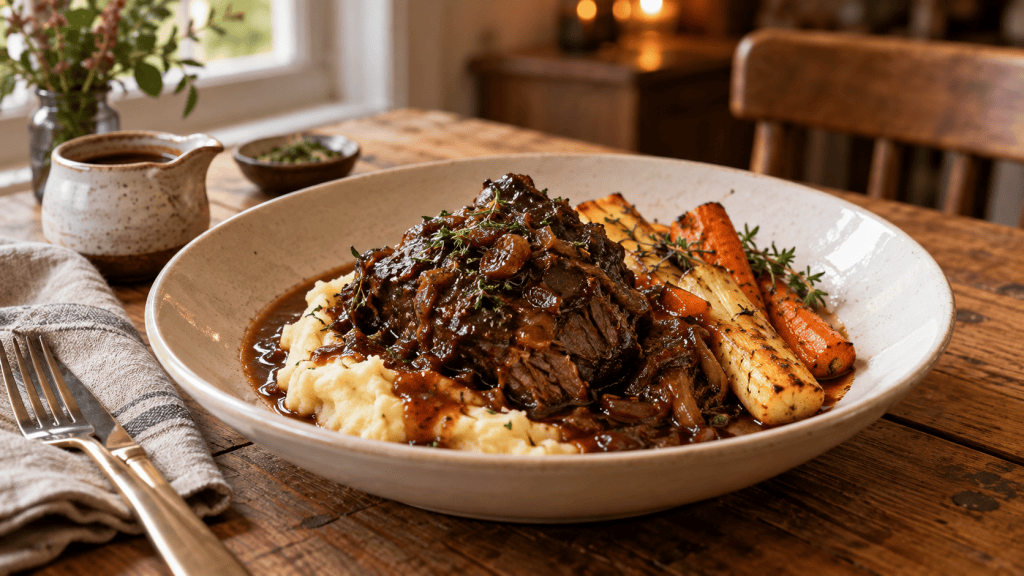
Slow-braised beef cheeks with red wine, whiskey and redcurrant gravy, served with mashed potatoes and roasted roots. Leonard’s favourite.
By October, I’m thinking about gravy again. The evenings are shortening, the fire is being lit, and I want a dinner that needs a deep plate. Mashed potatoes, something cooked slowly, enough sauce for whoever comes back for more.
Beef cheeks would be high on the list. I cook them the day before, then give them another spell in the oven before serving. Roasted carrots and parsnips alongside, perhaps some red cabbage. It’s a good dinner to have ready when everyone comes through the door hungry.
Whenever I make them, I think of Leonard.
He was our school caretaker and helped me cook the annual Christmas dinner for roughly eighty people. The beef cheeks were his favourite. When I suggested chicken stroganoff for our last dinner, he was horrified.
“That won’t do at all, Kieran! Go away out of that. What are you really cooking?”
I was really cooking chicken stroganoff. At least, I had been until that conversation.
Chicken stroganoff, apparently, was letting the side down.
I thought of the duck, the lamb shanks, the stuffed pork steak. I thought, too, of the year he and Joan Ward had prepared more than forty pineapples for baked Alaska and both come out in a rash.
It seemed, we were ready for another adventure.
The dinners began after I secured a grant from the Mercy Sisters’ Solidarity Trust Fund to build a cookery room in the school. Each Christmas, staff, the board of management, the parents’ association and others were invited to a sit-down meal.
We started with turkey and ham. A sensible beginning. In the years that followed, we served duck, fisherman’s pie, stuffed pork steak, lamb shanks, beef cheeks and braised beef. There was chowder among the starters, and a warm pear and blue cheese salad.
Every year, I wanted to try something different. By the time we gathered to prepare it, I had spent weeks planning the menu and ordering food. There was always a point when I wondered why I hadn’t simply chosen turkey and ham again.
The baked Alaska year would have been one of those.
I liked the idea of serving it in pineapple shells. I had given rather less thought to the work involved in producing more than forty of them. Leonard and Joan, who was with us on work experience and helping that year, did the coring and preparation.
Both developed a rash.
It seemed a considerable price to pay for dessert, but it did nothing to diminish Leonard’s appetite for an ambitious menu.
The day before the dinner, the cookery room was ours. Leonard, Noreen, our secretary, and Áine, Anne and Catherine, our SNAs, helped me every year. For two days, we had different jobs to do, with a meal at the end of them.
We worked well together. We had great fun, too, and I looked forward to those days even while wondering whether I had ordered enough, allowed enough time or chosen something that would prove awkward when we came to serve it.
Thirty years of cooking in commercial kitchens hadn’t cured me of the butterflies. Eighty people were coming for dinner.
In later years, Anne O’Donnell joined us and took over the desserts completely. I was delighted. Anne is a great cook, and I knew that part of the meal was in good hands.
Deciding what it would be took a little longer.
“Will I do bread-and-butter pudding?”
We would consider bread-and-butter pudding.
“No, they won’t eat that. I’ll call it something else.”
Then came the question of additions.
“Will I put chocolate in it? Or Baileys? Or both?”
There was also what to serve alongside it.
“Cream or custard?”
Or both. Both was frequently an option.
Eventually, we would agree on the pudding, what would go into it and what would accompany it.
“I think I’ll make a cheesecake,” Anne would say.
I always laughed. Whatever she settled on would be lovely. In the meantime, we had discussed enough desserts for several dinners.
The beef cheeks were easier to settle. They needed time, and our preparation day gave them that.
I browned them first, then cooked onions and carrots in the pan, followed by garlic and tomato purée. Red wine went in, whichever one I was using, with beef stock, a good splash of whiskey and redcurrant jelly.
I made plenty of sauce, keeping half back while the cheeks cooked in the rest. They had three and a half hours in the oven that first day. The following morning, I lifted them out, combined their cooking juices with the reserved sauce, then heated and strained it.
A little cornflour if it needed thickening, a knob or two of butter for a sheen. I like gravy that coats the meat and the potatoes. There should still be some left when someone asks for more.
The cheeks went back into the oven under foil for another two hours, with a generous amount of sauce poured over them.
It’s how I would cook them for an autumn Sunday, too, with the quantities reduced and a tray of root vegetables roasting alongside. Beetroot, carrots, parsnips. Red cabbage is lovely with them. The Brussels sprouts can wait until Christmas.
Leonard would be happy with the main course.
For dessert, Anne might do bread-and-butter pudding.
I wouldn’t buy the ingredients just yet.
Slow-Braised Beef Cheeks
With red wine, whiskey and redcurrant gravy
Serves six · Prepare the day before
Ingredients
- 6 beef cheeks, trimmed of excess fat and tough outer membrane
- 2–3 tablespoons oil
- Salt and freshly ground black pepper
- 2 medium onions, roughly chopped
- 3 medium carrots, roughly chopped
- 4 garlic cloves, chopped
- 4 tablespoons tomato purée
- 750ml red wine
- 100ml whiskey
- 1.2 litres beef stock, preferably not heavily salted
- 3 tablespoons redcurrant jelly, plus a little more to taste
- 3–4 sprigs fresh thyme
- 2 tablespoons cornflour, mixed with cold water, as needed
- 30–40g cold butter
To serve
Mashed potatoes and your choice of roasted beetroot, carrots and parsnips, or red cabbage. For Christmas, add Brussels sprouts.
The day before
1. Brown the beef
Heat the oven to 160°C conventional / 140°C fan.
Pat the cheeks dry and season with salt and pepper. Heat the oil in a large, heavy pan and brown the cheeks in batches, allowing approximately eight minutes per batch. Give them space to colour properly. Remove and set aside.
2. Make the sauce
Lower the heat and add the onions and carrots to the same pan. Cook for approximately ten minutes, stirring occasionally, until softened and beginning to colour.
Add the garlic and cook for a minute, then stir in the tomato purée and cook for another two minutes.
Pour in the whiskey and red wine, scraping the browned bits from the bottom of the pan. Simmer for five minutes, then add the stock, redcurrant jelly and thyme.
3. Reserve half
Transfer approximately half the sauce to a separate saucepan or container. Keep this for the following day.
Place the beef cheeks in a snug ovenproof casserole or deep roasting dish and add the remaining sauce and vegetables. The liquid should reach at least halfway up the meat; add a little water or stock if necessary.
Cover tightly with a lid or a double layer of foil.
4. Braise
Cook for approximately 3½ hours, until a fork slides easily into the cheeks. Larger pieces may need longer. Check during cooking and add a little hot water if the liquid is running low.
5. Cool and refrigerate
Cool the beef in its sauce and refrigerate promptly. For a large quantity, divide it between shallow containers so it cools quickly; refrigerate within two hours. Cool and refrigerate the reserved sauce separately.
On the day
6. Finish the gravy
Lift the chilled cheeks from their cooking liquid and place in an ovenproof dish. Remove any solidified excess fat from the sauce.
Combine the cooking liquid and vegetables with the reserved sauce in a saucepan. Heat, then strain through a fine sieve into a clean pot for a smooth gravy.
Bring to a simmer. Mix the cornflour with enough cold water to make a smooth slurry, then add gradually, stirring. You may not need it all. Simmer until the gravy is thick enough to coat the meat and potatoes.
Taste for salt, pepper and sweetness. Add a little more redcurrant jelly if needed. Stir in the butter for a glossy finish.
7. Return to the oven
Heat the oven to 160°C conventional / 140°C fan.
Pour a generous amount of gravy over the cheeks, keeping plenty back for serving. Cover tightly with foil and cook for approximately two hours, until piping hot throughout. Check that the dish has enough liquid during cooking.
8. Serve
Carefully pour the juices from the beef dish back into the remaining gravy and reheat.
Serve the cheeks over mashed potatoes, with roasted roots or red cabbage alongside and a generous helping of gravy.
I like a fairly thick sauce that coats the beef and potatoes. Make plenty—there should be enough for anyone who comes back for more.
Subscribe to Heron & Moss for new stories and recipes, delivered to your inbox. Next time, I’ll be cooking for fewer than eighty.


Leave a Reply