The Most Romantic Table in the House
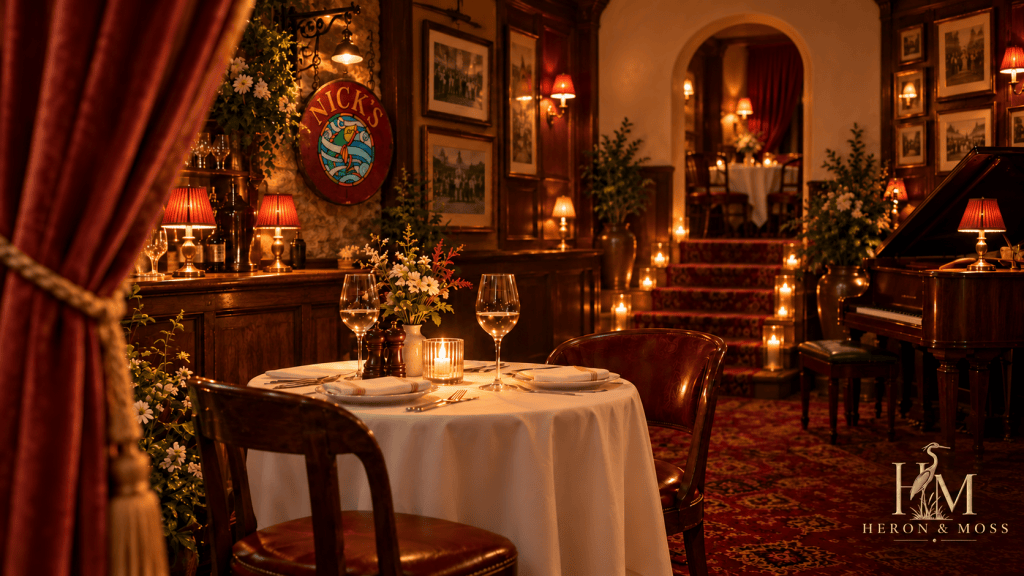
An AI-assisted artist’s impression inspired by my memories of Nick’s—the warmth, intimacy and atmosphere—rather than an actual photograph of the restaurant.
“Tell Claire to put her lipstick on,” Ann said. “And we’ll see what we can do.”
It was Valentine’s Day, and I had left it rather late to ask for a table at Nick’s.
By rather late, I mean I was asking on Valentine’s Day.
Around that time, I was giving grinds to one of the family. During a conversation with Ann, I cheekily asked whether there might be any possibility of squeezing Claire and me in that evening. Her expression told me how much I was asking. Every table would have been booked for weeks.
Still, she didn’t said no.
Anyone who knew Nick’s in Killorglin will understand why I wanted to go there. The three Georgian bay windows, the red-painted doors and that unmistakable fish sign made it recognisable before you ever crossed the threshold. Arriving for dinner, you already felt you were somewhere special.
When I try to picture the interior now, red is the colour that comes back first. There were red carpets, dark tiles, stone walls, a mahogany bar and timber panelling, with pools of light around the tables. It felt almost like being in the womb: enclosed, cosy, sheltered. Even on a busy night, you could settle into a corner and feel you had a little space of your own.
Pictures filled the walls, many works by Pauline Bewick among them, alongside photographs of celebrity guests, plaques and awards. There was plenty to catch your eye while you waited for dinner.
The bar faced you as you entered, with seating to the left and more tables and the baby grand to the right. Near the piano, an arched opening in the right-hand wall led up several steps to another dining level. At the far right, two more steps brought you to a few further tables. Follow that space around by the concealed stairs and you discovered another dining area again.
There was a larger room upstairs for groups, occasions and the overflow on busy nights. Back downstairs, beyond the right of the bar, another level held banquettes, tables and a fireplace.
You couldn’t take in the whole restaurant from the door. Every turn offered a different view: a table beside stonework, a corner close to the piano, a banquette near the fire. It was a place you could visit often and still have a favourite spot you hoped would be free.
Doors connected each dining space to the kitchen. Having worked there before becoming a customer, I knew something of the activity behind them.
From my position beside the starters section, I watched the docket board fill and the plates go out. Beyond the kitchen, customers were spread across all those levels, enjoying their evening. Keeping them fed took considerable work.
Nick’s cooking was the reason many of them had come. For decades, the restaurant was a landmark in Killorglin for great food, a menu people looked forward to and service that made going out feel like an occasion. People still speak about his cooking now.
Ann knew the dining rooms as thoroughly as Nick knew his kitchen. She knew who had arrived, who was waiting and who might need a little attention. She had a charm that put people at ease, whether they were familiar faces or coming through the red doors for the first time.
On a busy night, around ten o’clock, Nick might look at the full docket board and decide that we had taken enough tables.
Ann would appear in the kitchen and assess the situation. When the pressure began to ease, another ticket might emerge from one of her pockets.
There was someone she hoped we could accommodate.
She would explain who they were and why she wanted to find room for them. Perhaps they were regulars, perhaps they had travelled a distance, perhaps they were celebrating something. I had watched enough of those conversations to know that my Valentine’s request was in good hands.
That evening, Claire and I went to Nick’s.
Ann led us to a small table tucked behind a curtain near an exit door. In a restaurant already full of couples who had organised themselves considerably better than I had, she had found a corner for us.
The most romantic table in the house, she told us.
We smiled and sat down. She had taken the trouble to fit us in, then welcomed us as though our table had been waiting all evening.
Around us, the restaurant was busy. Behind our curtain, we had a little privacy and dinner to look forward to. My last-minute planning had worked out rather better than I deserved.
Dinner at Nick’s could be only the beginning of the evening. When JP was at the baby grand and the singsongs started, there was every reason to stay. People gathered around the piano, and the nights ran into the early hours of the morning.
Good food, good service and a roomful of people enjoying themselves: Ann and Nick sustained that combination for decades in the heart of Killorglin.
They are retired now, and the restaurant has closed. Mention Nick’s, though, and someone will remember a dish from the menu, a celebration upstairs or a night around the piano with JP. Others will speak about Ann and the welcome she gave them.
I remember those things too. But I also remember a table for two that I had no business expecting to get on Valentine’s Day.
Behind the curtain, near the exit door.
Ann’s most romantic table in the house.
If you enjoyed this visit back to Nick’s, subscribe to Heron & Moss for new stories of food, places and the people behind them, delivered straight to your inbox.


Leave a Reply