Before the Tide Came In
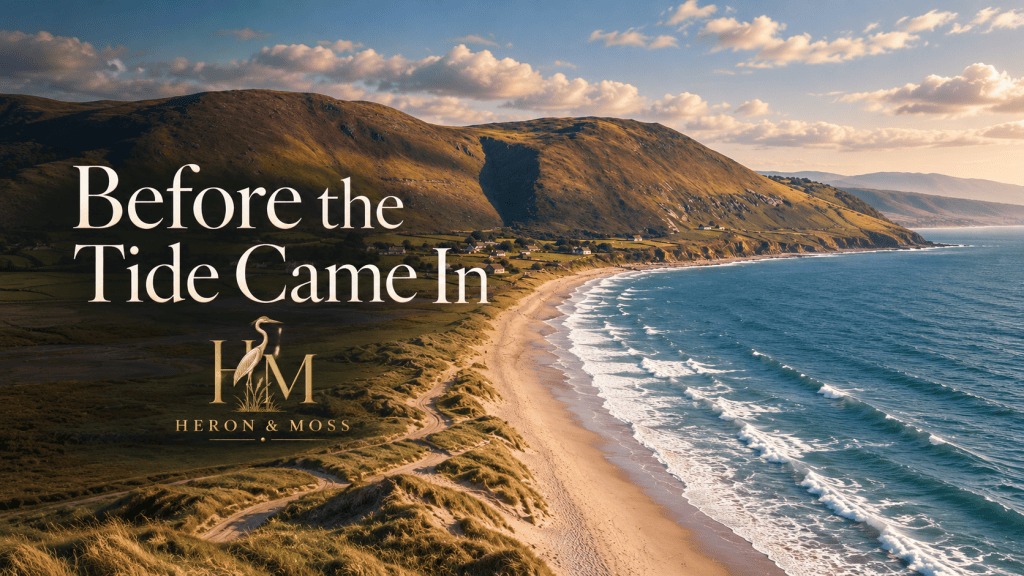
Rossbeigh, County Kerry — the setting for Before the Tide Came In. AI-created illustration.
Claire and I were by the fire one Wednesday evening, a glass of wine each and the telly on, when Mary McBride called in to see her about bridge. They play in Killorglin on Tuesday nights, and there were a few matters to discuss. I had settled in for the night. If you had asked me then what I expected to be doing before bed, reading about nineteenth-century coastal engineering would have been a long way down the list.
In the course of the visit, Mary mentioned a meeting she had been to in the Towers Hotel some months earlier, about the future of Rossbeigh. There is grave concern about what is happening there. Much of the dune system has been lost in recent years, and the sea has broken through the spit, leaving part of it cut off from the shore at high tide. For those of us who know the beach, it is hard to look at old photographs without trying to place ourselves in them, remembering where we walked and how far the dunes once ran. You can know that erosion is happening and still be taken aback when the old view is put beside the new.
Mary told us about the people who had spoken at the meeting that night. I knew Rossbeigh well, or thought I did. Listening to her, I realised how little I knew of how its shore had been formed, how it had changed before, or what people had already tried to do to protect it.
One of the things she mentioned was the old timber posts on the strand, and a man called Winn who had worked in India and written about protecting the coast. That was the part I wanted to hear more about. An engineer had stood on that beach more than a century ago, watching the sea advance and trying to persuade it to leave enough sand and stone behind to protect the land. I wanted to know who he was, what he had built, and whether the posts now showing on the beach could be his.
The television was still on, but I had stopped following it. Before Mary left, I knew I wanted to write something. She had come to talk about bridge, and in telling us about an evening in the Towers she had given me a reason to look at Rossbeigh again. Afterwards I began reading about Rowland George Allanson-Winn and his work at Glenbeigh in the late 1890s. As I read, I found myself wondering about the men who had carried the timber down to the shore, and about their families. Winn left an account of what he hoped his groynes would do. I began to imagine a boy working beside his father on the beach, earning his first wages from a man whose family name was already well known in their house.
Before the Tide Came In
My mother washed my good shirt on the Thursday, though I was not leaving until Sunday. She had it hanging on the chair when I came in, the collar spread over the back to dry, and she was rubbing at a mark on the cuff with her thumb. My father ate his supper beside it. He had pulled his chair closer to the fire and the shirt was touching his shoulder, but he did not move it or ask why it was there. I had told him about the passage three nights before. Since then he had asked me whether the cow had been let out and where I had left the hammer, and once, when I was standing between him and the light, to get out of the way.
I was twenty-one. I had been talking about America since I was sixteen, and for most of those five years I had wanted somebody to make it possible for me to go. Now the fare was paid, my mother had the shirt washed, and I would have given a great deal for my father to ask me to stay. It was the work on the strand that first put money of my own in my pocket. In the summer of 1898 men were wanted to carry timber, dig at low water and drive posts into the beach, and my father went down on the first morning without telling me. I followed him. He was standing with the others above the shingle, his trousers tied below the knee, and when he saw me he turned away. I thought he was ashamed to have me looking for work beside him. It did not occur to me that he might have wanted to get a day’s pay before bringing another mouth to the man who was giving it out.
The engineer asked my age. I said seventeen. My father, who had been examining the end of a plank as if something had gone wrong with it, said, ‘Sixteen,’ and I could have struck him for it. The engineer looked from one of us to the other, then put me with two men carrying boards from the cart. For the rest of the morning I took more weight than I could manage. By dinner my arms shook so badly that I had to hold the bread in both hands, and when my father sat down beside me I got up and went to drink at the stream.
His name was Allanson-Winn. I had heard Winn before I ever saw him, though at home it was usually said with something after it. When I told my mother who was paying us, she stopped scraping the pot. My father took off his boots and set them by the hearth, the toes pointing out into the room. Neither of them spoke until she asked whether we would be wanted the next day. He said we would. She put more potato on his plate and passed the pot to me.
I knew about the eviction. Everybody knew I knew, which meant that nobody had ever thought to tell me the whole of it. I remembered our dresser outside and rain shining on the plates, and my mother telling me to stand where she could see me. There was a man at the gate with a little book. For years I thought it was he who had burned the roof, because he was the only man whose face I could remember. My father said the man with the book had not lifted a hand against us, and the way he said it did not seem to clear him of anything. We got back into the house afterwards. The walls were raised and a new roof put on, and by the time I was old enough to be sent for things I knew which corner of the kitchen had to be kept clear when the rain came in. There was one cup without a handle on the dresser. My mother kept salt in it. I asked her once if it had been broken the day we were put out, and she said she could not remember. I was disappointed. I wanted her to remember something I could be angry about, something with a beginning and an end that I could put beside what I saw every day. She told me to stop standing there and bring in the washing.
The engineer spent a good deal of time watching us work. He had a notebook and a way of putting one foot up on a stone while he wrote, which made him look as if he had all the time in the world. My father could not bear that. He would keep working after the others stopped, driving at a post with the iron bar until the veins stood up at his temples. I began watching for the moment when the engineer would notice. When he did not, I was angry with him. When he did, I was afraid he would say something and my father would answer him. One afternoon the engineer asked me why the shingle lay higher on one stretch than another. I told him what my father had told me, about the winter seas and where the stones travelled, about the places where a man could once have stood that were under water now. He asked another question, and another. I found I could answer them. There was a pleasure in it that made me talk too quickly.
He opened his notebook and I slowed down, giving him time to write, looking away while he did it as though men had been writing down what I said all my life. My father was working a little way off. I could hear the bar striking, then the scrape as he lifted it again. The engineer asked how I had come to know so much about the shore. I said I had always lived there. It was true, and I knew as I said it that I was letting him believe something else.
At supper my father asked what the engineer had wanted. I told him. He waited while I finished, pulling a small bone from the fish with his fingers, and then he said, ‘You might have told him who showed you.’ My mother looked at me. I said he had not asked that. My father laid the bone on the edge of his plate. I could have put it right then. I could have said I was sorry, or that I would tell him the next day. Instead I went on eating, and after a while my father asked my mother for the bread. I did tell the engineer. I waited until we were alone and said that most of what I knew had come from my father. He glanced towards him and said, ‘Yes, I thought it might.’ That was all. I had expected surprise, perhaps an apology for overlooking him, and I was left with the disagreeable feeling that my cleverness had been less remarkable than I supposed. My father never knew I had spoken. I did not tell him because I wanted him to ask.
On Saturdays we were paid in the yard behind the hotel. My father put his money straight into his pocket. I counted mine while the others were still there. The first week I bought tobacco I did not like and paid for a drink I could not finish, and went home with less than I had meant to give my mother. She counted what I put on the table and asked for nothing else. Later she came out while I was splitting sticks and stood beside the block. She had a sixpence in her hand. ‘Keep something for yourself,’ she said. I told her I had, and she stood there with the coin between her fingers until I stopped pretending to look for a straight piece of wood. I began putting money away after that.
My mother’s cousin in Boston had written that there was work, and that his wife would make room for me until I found somewhere. I kept the letter in a mustard tin beneath a loose flag by the hearth. Sometimes, when my father was out, I took it up and counted what I had. My mother went about the kitchen without looking. Once she asked whether the cousin had said anything about the winters. I said I did not mind cold. She said, ‘I know you don’t,’ and went on peeling the potatoes.
The groynes began to collect shingle. We had carried and driven and bolted the timber into place, and now there were stones banked against it where the sea had been reaching the cliff. My father went down on Sundays to look, though he would not have called it that. He would say he was going to see whether somebody had left a tool behind. I went with him one evening and we stood looking at a stretch we had worked on together. He pointed to a board and said it would want another bolt. I said the engineer had seen it and thought it would do. He turned to me then. ‘Well, he’ll be the man carrying it back up the beach, so.’ I laughed. I had not heard him make a joke about the work before, and I laughed too much. He looked away and started up the bank. For the first time that summer I had the sense that I might be allowed to work beside him without spending every hour trying to get out from under him.
When the engineer left, he gave me an address and asked me to write after the winter. I did. I wrote on the table after supper while my father sat by the fire, and I read out the parts about the shingle because I wanted him to correct me. Sometimes he did. More often he said nothing, and I had to decide whether that meant I had it right. I wrote the address carefully on each envelope. My mother kept the first reply in the dresser with the Boston letters, and when a neighbour came in she found a reason to leave it where it could be seen.
I did not go to America that year, or the year after. There was work when there was work, and money was needed at home, and once I had bought the boots I said I would need for travelling I began wearing them to Mass. The tin filled and emptied. I was ashamed of it, then accustomed to it, and by the end of 1902 I had stopped telling people I meant to go. After a storm in January, my father brought a plank home from the strand. One of the groynes had been damaged again and loose timber lay among the stones. He carried the plank on his shoulder, with an iron bolt still through one end. I offered to take it at the gate, but he went past me and into the house. That evening we fixed it above the inside of the door for a shelf. He held it while I drove the nails, and when I missed and struck the whitewash he said nothing. He had begun to let me do the hammering. I had noticed it before that evening, but I had not let myself think about why.
The letter from Boston came in February. The cousin had work for me if I could come in the spring. He could not promise to hold it longer. I read that part to my mother and she asked me to read it again. My father was out. When he came in she told him there was a letter, and I wished she had waited until I could leave the room. He washed at the basin and asked what the cousin had said. I told him. He dried between his fingers slowly, working the cloth into the places where the skin had split. ‘You’d better answer him, so,’ he said.
I bought the passage before I told him I had decided. That was the part I could not explain afterwards, even to myself. He had told me to answer. He had not forbidden anything. Still, I waited until the money was gone and the date fixed, and then I stood in the kitchen and spoke to him as though I expected a quarrel. He listened. My mother was sitting by the window with a stocking over her hand, and I remember wanting her to interrupt. When I finished, my father asked which Sunday. I told him, and he nodded, and that was the beginning of the days in which he spoke to me about the cow and the hammer and nothing else.
On the Saturday night I came in late. He was in bed and my mother was folding the shirt. I asked her whether he was angry. She said I should ask him. I said there was no point, and she set the shirt down. ‘He came home to tell me they’d taken you on,’ she said. ‘That first morning. Before you came up for your dinner.’ I waited. She lifted the shirt again, folded the sleeves across it and smoothed them flat. ‘He said you were able for it.’
I went outside because I could not bear her looking at me. There was a light in the bedroom and I could hear my father coughing. I stayed by the gate until it went out. I had spent nearly five years waiting for him to say something that would make me feel grown, and all the time he had said it to my mother in a kitchen I was hurrying home to leave.
We had to be away early on Sunday. My mother made tea and cut bread, and my father stood my bag beside the door. I had packed it so tightly that the strap would barely reach. He undid it, took the bag onto his knee and worked the buckle back through the leather. I was watching his hands when I said I should have told the engineer about him that first day. He kept his head down. ‘You told him enough to get the thing built,’ he said. I said that was not what I meant. ‘I know what you mean.’ He pulled the strap tight and put the bag down. My mother was wrapping bread for the journey. My father reached for the tea and found his cup had been packed away with the breakfast things. He took the handleless one from the dresser, tipped the salt into a saucer and wiped it out with his thumb. Then he poured the tea and drank it standing, holding the cup at the rim. My mother told him he would burn his fingers. He set it on the shelf above the door, took my bag and opened it. I had meant to say I would be back for Christmas, though I had no way of knowing whether I could. In the end I went after him. My mother followed us as far as the gate, with the bread still in her hand.
The narrator and his family are invented, as are their conversations and their part in the work. Winn’s coastal works at Glenbeigh and the evictions of 1887 are historical. The plank on the shelf is imagined too, and tells us nothing about the timbers on the beach today. What follows is my own reading of the history, written as someone who loves Rossbeigh and not as a coastal engineer. Any errors are mine, the people whose work I draw on have not endorsed this piece.
Rossbeigh’s dunes have suffered severe erosion. As the beach changes, it sometimes uncovers the timbers of older attempts to protect it.
In November 2023, rows of old timber posts were exposed at Rossbeigh. In a submission to Kerry County Council, a local contributor with an engineering background described lines of them running out from the shore at roughly sixty-metre intervals, normally hidden under sand. He photographed the structures and surveyed the changing beach. From his cross-sections, he estimated that one stretch of frontage had lost twenty-three cubic metres of stone for every metre of its length. His report does not say when the timbers were put there, or by whom. That question leads back to Winn, and into a larger story about the beach itself.
Glenbeigh’s Irish name, Gleann Beithe, means the glen of the birch trees. The Behy river runs beside the village, and the shore has long had its place in local stories of Oisín, Niamh and Tír na nÓg. Rossbeigh is a coastal barrier, usually described as a spit: a tongue of shingle, sand and dunes
reaching out into Dingle Bay. With Inch and Cromane, it helps shelter Castlemaine Harbour. Its shape depends on waves, currents and the movement of sediment, and it can change greatly over time. A spit is never quite still. Sand comes and goes with every tide and storm. The dunes are the shape that balance takes for a while.
On the hill above the village stands the ruin known as Wynn’s Castle, or Wynn’s Folly. Its formal name was Glenbeigh Towers, built between 1867 and 1871 for the Hon. Rowland Winn, father of the engineer. The family spelled the name Winn, though both spellings turn up in print, and the names and titles are easily confused: the son, Rowland George Allanson-Winn, did not become Lord Headley until 1913. The architects were Edward William Godwin and Henry Crisp. The building leaked badly, and James
Franklin Fuller was brought in to repair it. Winn sought to recover the cost from the original architects, and the dispute was settled before it reached trial. The estate around the castle included very poor land, made workable by the labour of its tenants. In 1887 the MP Pierce Mahony published The Truth About Glenbeigh, describing cleared fields, rising rents, poverty and disputes between the owner and his mortgagees. He wrote in defence of the tenants, and his account should be read with that in mind. The evictions of January 1887, when homes were destroyed and burned, were also reported in the newspapers of the day.
The house was later kept by staff, and during the First World War it was used by the British military. It was burned in the early 1920s, in 1921 or 1922 depending on the source, and never rebuilt.
Rowland George Allanson-Winn boxed at Cambridge, studied law and later became an engineer. He worked on roads in Kashmir in the 1890s before turning much of his attention to coastal erosion in Ireland. His work included foreshore protection at Youghal and studies of other Irish shores. In 1906 he was appointed engineer for an extension to Arklow’s south breakwater, though his scheme was dropped in favour of another engineer’s design. In 1913 he inherited the Headley title and converted to Islam.
When he worked at Glenbeigh in the 1890s, he was still plain Mr Allanson-Winn. By his own reckoning, the sea had taken more than a thousand feet of land from one part of the Glenbeigh foreshore since 1842. His biographer records that in 1897 he advised the estate trustees about erosion threatening a road and houses. Part of his answer was groynes: barriers built across a beach to slow the drift of sand and stones. He hoped to hold back enough material to form a protective bank at the foot of the cliff, and he favoured low groynes, and groynes set at a slant, over tall ones.
Two box groynes had been built at right angles to the Glenbeigh shore in 1896, while Winn was out of Ireland. He later wrote that they had failed to collect material and had caused scouring on either side. He does not say who built them, and they should not be laid at his door.
In the summer of 1898 he completed three slanting groynes of his own. He later reported shingle building up at the foot of the cliff, and grass beginning to grow in places. His biographer also records a further commission for low groynes that year, and Winn’s hope of saving six hundred acres. Within five years, that hope had worn thin.
By March 1903 his view was much darker. In a report to the estate he admitted that the groynes had not done all he intended, and that one had been destroyed for the second time. That January the Sunbeam had been driven ashore at Rossbeigh. Whether the same storm took the groyne, I have not been able to establish. His reasoning came down to ground and money. More than two thousand feet of shore needed protecting, on foundations of sand and bog. A seawall, he believed, would in time be undermined, and any wall the estate could afford would not stand up to the sea. High groynes, he thought, would only make the damage worse. He advised against spending more on the low groynes, while leaving room for modest temporary works and for strengthening one of the slanting groynes. He did not come to that easily. ‘It is very much against the grain,’ he wrote, ‘thus advocating a policy of inaction.’
Photographs and local memory recall a beach you could once drive onto. The 2023 submission puts the end of vehicle access in the late 1970s. The record of what came next is clearer. Erosion intensified in the early 2000s, and in the winter of 2008–2009 the sea broke through. The breach cut the outer spit off from the mainland. The old navigation tower at the point later fell, in 2011 by most accounts, and a replica now stands outside the GAA grounds in Glenbeigh. The storms of early 2014 did further severe damage and shifted the wreck of the Sunbeam from where it had lain for decades.
Kerry County Council repaired coastal defences in 2014. According to a parliamentary answer of 10 February 2026, the OPW then approved €450,000 for a rock revetment designed by Malachy Walsh and Partners, with completion confirmed in 2019. A scientific paper published in 2020 recorded that, during the years it studied, the breach had grown to more than a kilometre.
A beach cannot be understood one protected stretch at a time. The local submission asks whether the rock armour has affected the shore on either side of it. It is a fair question, though answering it would take real evidence about waves, currents and the movement of sediment. Sand taken by the sea is not always gone for good. A 2020 study of Rossbeigh, covering 2001 to 2019, found an offshore sandbar moving towards the barrier and signs that the breach might one day heal, though it expected more storm erosion first. Winn would have understood. What happens below the water decides what we see on the beach. None of the sources I read settles on a remedy, and every option raised so far would need its own assessment. The local contributor asks whether groynes might be tried again; Winn’s experience
gives that idea a history, though not a verdict. Beach nourishment has also been suggested, placing suitable sand where the dunes have gone, and a council meeting in 2020 heard that Dutch visitors had proposed drawing it from the offshore sandbank. Another course would be to watch the natural
recovery the research describes, though homes and roads cannot be left to wait on it. And the existing defences could themselves be reviewed, though changing them would need evidence of what they now protect.
Rossbeigh lies within the protected landscape of Castlemaine Harbour, with its dune habitats and wintering birds such as the light-bellied Brent goose, and any proposal will have to account for them. The February 2026 parliamentary answer said Kerry County Council had made no further Rossbeigh applications under the OPW Minor Works Scheme. Whether other work is under way, it does not say.
So were the posts Winn’s? Possibly. His documented work makes him a credible candidate, but a row of timbers cannot name its builder or its date. They might belong to his groynes, to the box groynes of 1896, or to some later work. Nothing I have found, no plan, dated photograph or building record, settles it. An older photograph in the report shows taller posts, and what they were, or how they relate to the stumps there now, is another open question. The answers may still be out there. Winn’s paper The Constructive Power of the Sea appeared in volume 28 of the Transactions of the Institution of Civil Engineers of Ireland, published in 1902 and
sometimes cited as 1901, and his biographer points to pages 143 and 144 for Glenbeigh. Those pages, their illustrations and the estate records are the next places to look.
For now, there are the posts themselves, dark against the stones when the beach strips back.
If you enjoyed this story, subscribe to Heron & Moss and I’ll let you know when the next one is published.


Leave a Reply