Through the Same Door
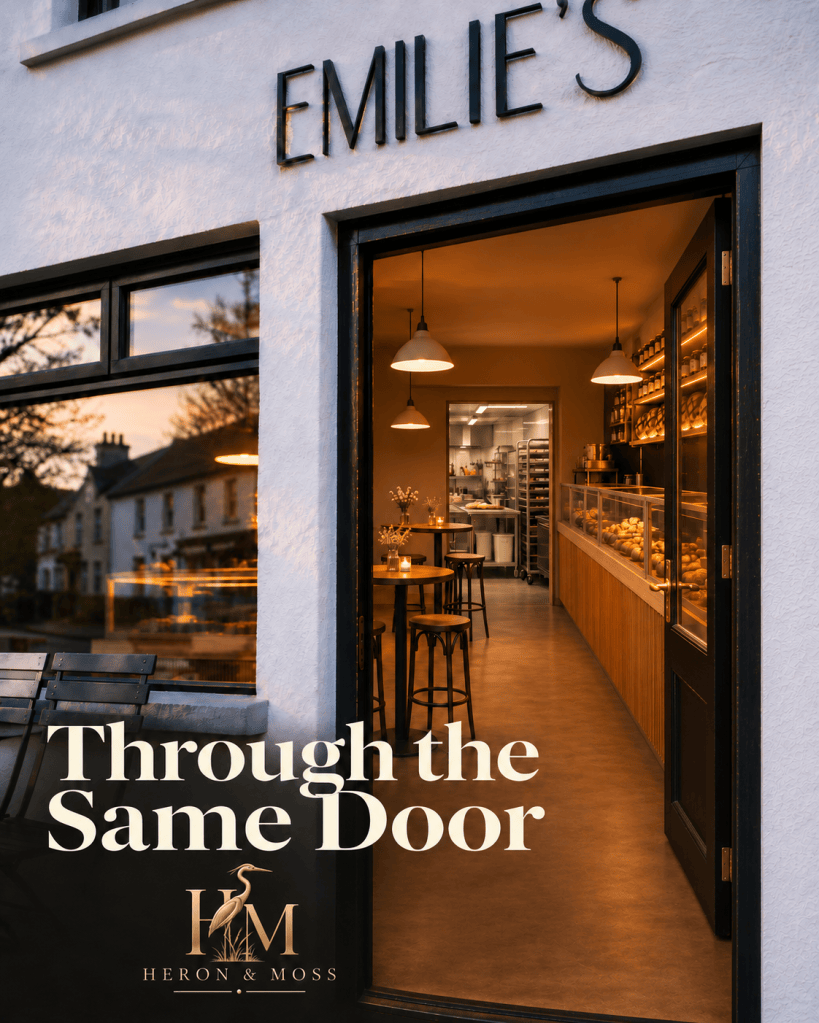
Through the same door in Glenbeigh. I used to go in for an ounce of pear drops at Margaret’s. These days I go in for coffee at Emilie’s.
Illustration inspired by Emilie’s shopfront and bakery.
I could walk all the way to Margaret’s for an ounce of pear drops and lose my nerve as soon as I saw the chocolate mice. The sweets were in clear plastic jars behind the counter, and some of them were high enough that I had to tip my head back to see what was in them. The money would be warm in my hand by then. I knew how much I had, but I’d count it again all the same. I’d have the pear drops eaten before I got home, but a gobstopper might last me the rest of the evening. I could stand at Margaret’s counter for a good while trying to decide which I wanted more.
There was a bell over the door of Margaret’s shop in Glenbeigh, and when you went in you could often smell whatever she or Nelius was cooking in the kitchen behind it. It might be breakfast, lunch or supper, depending on when you called. The cold meats were kept on one side of the shop and the sweets on the other. Straight ahead were open white shelves with bread and tins and packets of tea, and set into those shelves was a little window. Margaret and Nelius lived in the rooms behind and above the shop, and through that window I’d sometimes catch sight of her clearing away the supper plates. Then she’d disappear from view and a moment later she’d come through to the shop, smoothing her apron on her way behind the counter.
Three or four people would about fill the shop. There were several shops in the village then, so people came and went all day and there was rarely much of a crowd. In my mind Mrs Foley is always just inside the door, leaning on the counter. She lived across the road and I can still hear her laugh. She was as kind to us children as Margaret was, and there was always room for me to get in beside her and have a proper look at the jars. I might change my mind twice before Margaret got near the scales, and when I’d finally settled it, the two of them would pick up where they’d left off.
The scales were white enamel. The brass weight went into one pan and the pear drops rattled into the other. I watched the beam dip, then rise as Margaret took a sweet out. Once it settled she’d tip the sweets into a paper bag and fold the top over, and then, just when I thought she was going to hand it across, she’d reach back to the jars. It might be a jelly baby she slipped in or another pear drop. I’d have my hand in the bag before I was properly out the door, feeling for the extra one as if there’d be some way of telling it apart.
I still go through that door, though these days it’s for coffee at Emilie’s. The bakery and café takes in Margaret’s old shop and Andy McCarthy’s next door. There’s still a bell where Margaret’s hung, and it rings while my hand is on the door. The coffee is what I smell first, deep and warm, and a few steps in there’s the smell of breads and cakes from the bakery. There was soft jazz playing the last time I was in. I could hear it while I stood at the counter, looking at what had come out of the oven.
The sourdough loaves stand on their sides on a lit shelf, the flour still pale in the cuts where the crust has opened. There’s darker Guinness and walnut bread, too. I like getting a piece of walnut right up against the crust, where there’s a little bitterness to the bite. The croissants break into crisp flakes at the ends and give way to soft frangipane in the middle. There are crumble pies, homemade cookies, chocolate tarts among the many delicacies on offer, and I can never look at them without thinking of the first spoonful, when the buttery crumbs fall apart. Then there’s the long piece of toast laid across the rim of a brown earthenware dish, with two poached eggs, sliced avocado and a strip of bacon above it. I’d break the toast with my fingers and use the rough edge to catch the yolk. I can’t be quite sure I’m only having coffee when I push open the door. By the time I order it, I’m usually asking for something on a plate as well.
The chairs have wooden seats and iron legs like the ones we had at school. Under them the polished concrete has patches of ochre. I still can’t tell whether somebody sanded back an old painted floor or went to the trouble of giving a new one that look. There’s a similar colour in the rough plaster, chipped here and there. Some of the prices are written by hand on the edges of the shelves, and a few right on the shoulders of the wine bottles. Farther back, in what used to be Andy’s, there are big sacks of flour on the shelves along the wall. I think I’d miss those sacks if somebody found a tidier place for them.
I’d be delighted to come across a place like Emilie’s on a side street in a city. There’s something of a French bakery in the croissants and the rows of bread behind the counter, and later in the day there’s the smell of pizza from the wood-fired oven. The shelves have the care of a good deli, with oils and cheeses and jars of things I sometimes have to turn around to see what they are. I like being tempted to bring home something I’ve never tasted. And all of this is in a little village in the southwest of Ireland, through a door I’ve been opening since I was a child. There’s a pleasure in having somewhere like that to take somebody who’s visiting, and another pleasure altogether in being able to say to a friend, ‘Will I see you in Emilie’s?’
On your way through the shop you can see into the working bakery. It was the sight of somebody moving about on the other side that brought back Margaret’s little window, and with it the supper plates I used to see as a child.
If I were drawing Margaret’s shop now, I could put in the white shelves, the counter and the scales from memory. I’d put Mrs Foley in just inside the door. I know exactly where her elbow would go. I can see her there as clearly as I can see Margaret behind the counter, and I’d find it hard to draw the two of them standing still. In my head they’re nearly always laughing. Margaret might turn away to get something from a shelf or come down the counter to weigh out my sweets, and Mrs Foley would still be there when she turned back. I doubt I could have told you what a good friendship looked like at that age, but I knew these two were glad of one another. I think now of how much of Margaret’s day was spent behind that counter, and how lovely it must have been to look up and see Mrs Foley coming in from across the road.
When I go into Emilie’s to meet friends, I look for them before I look at what’s on the counter. I like seeing someone I know sitting there already, and I like the sound of a stool being pulled out when somebody else comes in. We’ve usually come for coffee, though if one of us has something to tell, the cups can sit there a while before anybody takes a sip. I spend a lot of time thinking about how to arrange a room, and I’m fond of the way Emilie has arranged this one. You can sit with a cup and watch the bakery at work, or sit in at a table and spend the next half-hour looking at nothing but the faces of the people you came to see.
The other day I asked Emilie for five salted caramel protein balls to share with my friends. She picked them up with the tongs, counted them onto a side plate, then reached back for a sixth. ‘Ye can fight over that,’ she said, laughing.
For a second I could see Margaret’s hand going back to the sweet jar, the top of the paper bag already folded.
If this story brought back the sound of a bell over a shop door you once knew, I’d love to have you along for the next one. Subscribe to Heron & Moss and I’ll send new stories straight to your inbox.


Leave a Reply